Why Does My Stomach Growl? It's Not Always Hunger
Stomach growling is the sound of the stomach and intestines pushing food, fluid and gas along. When you are fasting, regular waves of contractions make it louder. It is usually normal, but with other symptoms it is worth seeing a doctor.
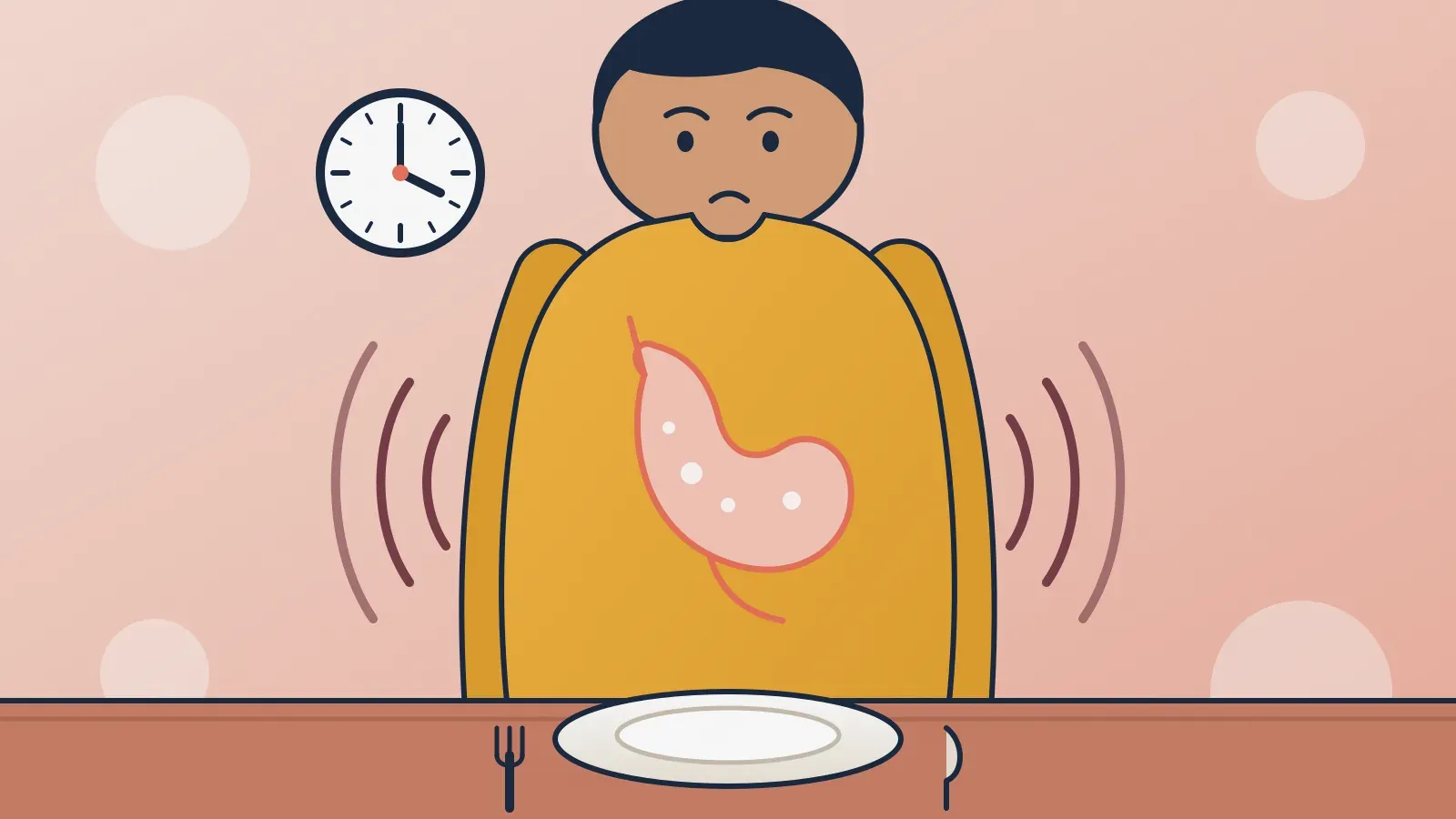
Your stomach growls because your stomach and intestines are constantly squeezing to push food, fluid and gas along, and that movement makes noise. The sounds are called borborygmi. They get louder when you haven't eaten for a while: the gut is nearly empty, and waves of contractions that repeat every one to two hours echo with nothing to muffle them.
Where does the growling sound come from?
The digestive tract is lined with muscles that contract in waves, a movement called peristalsis. As they squeeze and push the contents along, they also move swallowed air and gases made by gut bacteria. The result is gurgles, rumbles and pops that can sometimes be heard across the room.
Despite the name, growling does not come only from the stomach. It also comes from the small intestine. And the exact source of each sound is still uncertain, as Harvard Health Publishing, from Harvard Medical School, acknowledges.
The technical name goes back to ancient Greek. Borborygmus is onomatopoeia, a word that tries to imitate the rumbling itself, and it is what the ancient Greeks called a growling belly.
Why does my stomach growl more when I'm hungry?
About two hours after the stomach and small intestine empty, a pattern of activity called the migrating motor complex kicks in. It sweeps through the stomach and small intestine in phases, and the most intense one is a series of strong contractions that travels toward the large intestine. These contractions can last 10 to 20 minutes and repeat every one to two hours until your next meal.
With everything empty, there is no food to dampen the sound, so the growl is louder. Hormones are part of the cycle: given intravenously, motilin and ghrelin, a hormone linked to appetite, can both trigger the strongest phase of the complex.
What are those fasting contractions for?
The role of the migrating motor complex is not fully understood. One clue comes from what happens when it fails: its absence has been linked to gastroparesis, in which the stomach empties too slowly, to intestinal pseudo-obstruction and to bacterial overgrowth in the small intestine. That suggests these waves help keep the gut clear between meals.
In other words, a hungry growl is more of a side effect than a signal. Harvard Health advises against assuming that every growl means it is time to eat: a much more reliable sign is actually feeling hungry. And eating does not always stop the noise.
Why does my stomach growl when I'm not hungry?
Digestion after meals is noisy too, and some things turn up the volume. Harvard Health lists:
- Swallowed air, for example from drinking carbonated beverages.
- Gas-producing foods such as beans, cabbage, Brussels sprouts, broccoli, cauliflower, peas and oat bran.
- Fructose, found in fruits like prunes and pears, and sorbitol, used in some sweetened products.
- Conditions such as lactose intolerance and irritable bowel syndrome, which can increase gas.
Burping, by the way, works as a release valve: according to Harvard Health, it helps keep the pressure inside the digestive tract low. Your digestive system makes other involuntary sounds too, such as hiccups, which start with a sudden contraction of the diaphragm. And the animal world offers a contrast: unlike a growling stomach, which is a by-product of digestion, a cat's purr is a sound the animal actively produces.
When should you see a doctor about stomach noises?
Doctors pay attention to how loud the sounds are, too. According to MedlinePlus, increased or hyperactive bowel sounds mean more activity in the intestines and can occur after eating or with diarrhea. Reduced or hypoactive sounds mean the intestines have slowed down, which is normal during sleep and for a short time after certain medicines or abdominal surgery.
Most of the time, the noise simply shows that your gut is working normally. MedlinePlus, the medical encyclopedia of the U.S. National Library of Medicine, and Harvard Health recommend seeing a doctor when growling comes with other symptoms, such as:
- Abdominal pain or cramping.
- Bloating, nausea or vomiting.
- Diarrhea or constipation that does not go away.
- Bleeding from the rectum.
According to Harvard Health, very loud or high-pitched sounds together with bloating, cramps, nausea and vomiting can point to a blocked intestine, and an absence of sounds combined with abdominal pain also worries doctors. In those cases, get checked promptly. Without any of that, a rumble in the middle of a quiet meeting is just your gut sticking to its routine: embarrassing, but healthy.
Sources
- Scientific American: Why does your stomach growl when you are hungry?
- Harvard Health Publishing: Stomach growling and other digestive noise
- MedlinePlus (U.S. National Library of Medicine): Abdominal sounds
- Nature Reviews Gastroenterology & Hepatology (via PubMed): The migrating motor complex: control mechanisms and its role in health and disease