Why Do Cats Purr? It Isn't Always a Sign of Happiness
Purring starts in the larynx and shows up during cuddles, but also during stress, pain and dinner-time begging. Here is what science knows and what is still a hypothesis.
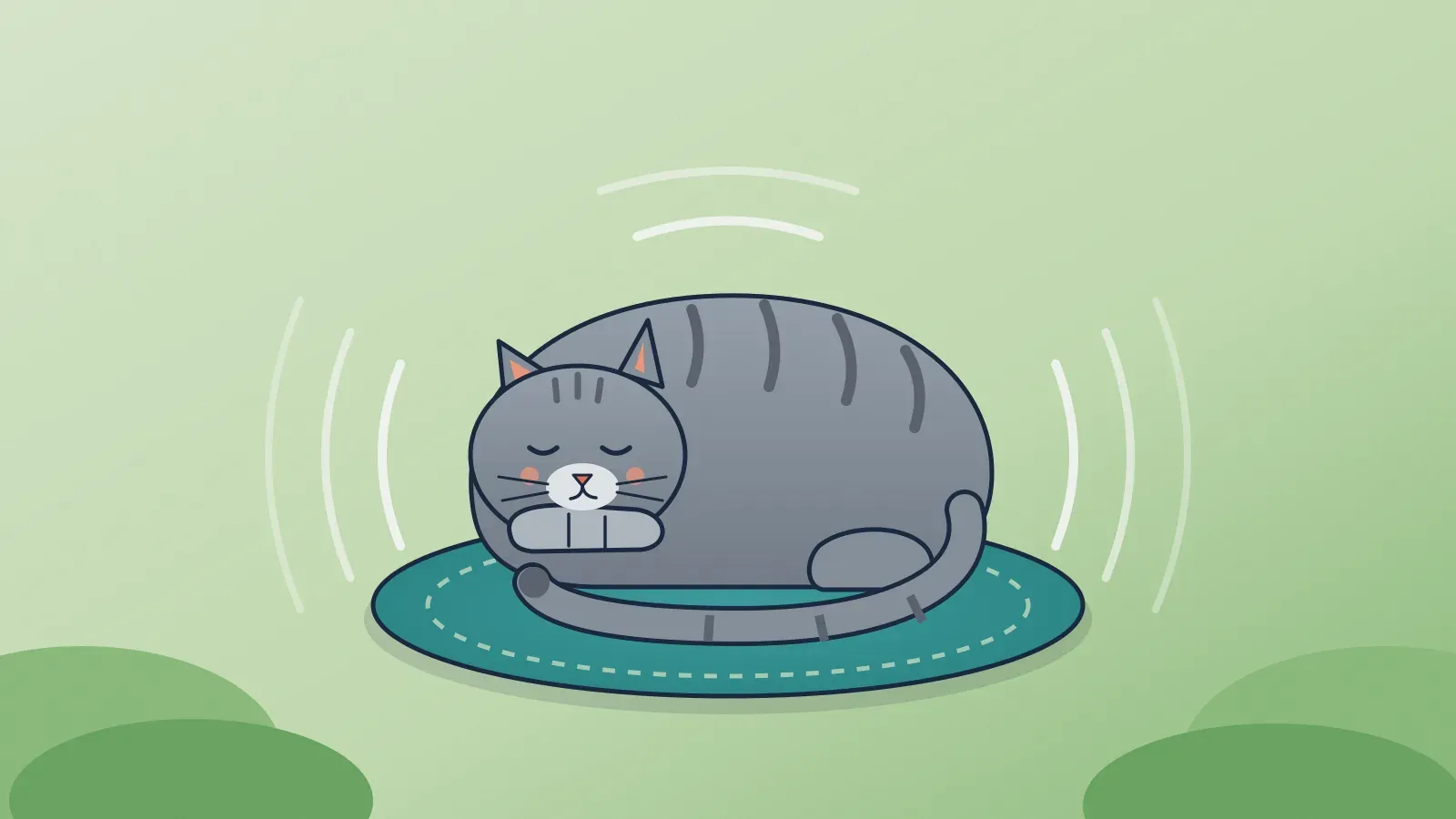
Cats purr with their larynx: air moving in and out makes the vocal folds vibrate at a very low pitch, roughly 20 to 30 times per second. Cats purr when relaxed and being petted, but also when stressed, hurt or hungry. A purr is a form of communication, not a reliable happiness meter.
Where exactly does a purr come from?
For decades, the leading explanation was that the brain sends intermittent signals to the muscles of the larynx and diaphragm, which contract in a steady rhythm and interrupt the airflow. The result is a rumble with a consistent pattern and frequency on both the in-breath and the out-breath, which is why a purr sounds continuous.
In 2023, a study in the journal Current Biology, led by Christian Herbst of the University of Vienna, complicated that story. In the lab, larynges from domestic cats produced purr-range sounds of 20 to 30 Hz with nothing but airflow, without any nerve signals or repeated muscle contractions. The team also found a distinctive pad of tissue inside the vocal folds that may help such a small animal make a sound lower than the deepest human bass voice.
The mechanism resembles vocal fry, the creaky voice many people slip into at the end of a sentence. It is the same basic physics behind your own voice, which sounds so strange on a recording: air passing over vibrating vocal folds. The authors stress that this does not completely overturn the older theory. It shows the brain may not need to drive every single vibration, and that the topic still needs more research.
Does purring mean a cat is happy?
Not always. The purr most people know happens in calm, social moments: a mother nursing her kittens, a cat on a lap, a good scratch, feeding time. In those settings it is reasonable to read it as contentment, although nobody can be certain what the animal is feeling.
But cats also purr when they are stressed or injured, for example during a visit to the vet or while recovering from a wound. Leslie Lyons, then at the University of California, Davis, School of Veterinary Medicine, told Scientific American that the most plausible reasons for purring are communication and, possibly, some form of self-healing.
That is why the sound alone tells you little. You have to read the context and the rest of the body. A cat that purrs while hiding, hunched up or unusually quiet is not necessarily fine, and if its behavior has changed, a veterinarian is the right person to take a look.
Can purring help heal bones?
This is the most famous idea and the least proven one. According to Scientific American, purrs fall between 25 and 150 Hz, and various researchers have shown that sound in that range can improve bone density and promote healing. That led to the suggestion that purring might be a low-energy way to stimulate bones and muscles while a cat rests.
Some people take it further and use it to explain the legend of nine lives, or the fact that cats seem to have fewer bone and muscle problems than dogs. The article itself calls these links speculation. No one has shown that purring speeds up the healing of a cat's own bones, let alone that it works as a treatment for people.
Is there a special purr for asking for food?
There is, and anyone who lives with a cat has probably heard it around mealtime. In 2009, a team led by psychologist Karen McComb at the University of Sussex in the UK described it in Current Biology. They called it the solicitation purr: a low purr with a high-pitched element, similar to a cry or meow, embedded inside it.
- Listeners compared recorded purrs played at the same volume and rated solicitation purrs as more urgent and less pleasant.
- The result held even for people who had never owned a cat.
- When the researchers removed the high-pitched element, the purrs sounded less urgent.
In practice, it is a request for food dressed up as a pleasant sound, hard to ignore without being as grating as a nonstop meow.
Do all cats purr?
Most species in the cat family make some kind of purr-like sound, but it is most noticeable in domestic cats. Like the reflex that lets them almost always land on their feet, purring is one of those skills that look simple and hide surprisingly sophisticated anatomy.
On the living room couch, that soft rumble might mean “I'm fine,” “I'm tense” or “where's dinner?” Science now knows where it is made. Working out what each purr means still depends on paying attention to the whole cat.