How Do Owls Turn Their Heads 270 Degrees Without Cutting Off Blood to the Brain?
With eyes fixed in their sockets, owls have to turn their whole head. A Johns Hopkins study revealed the neck adaptations that keep blood flowing to the brain.
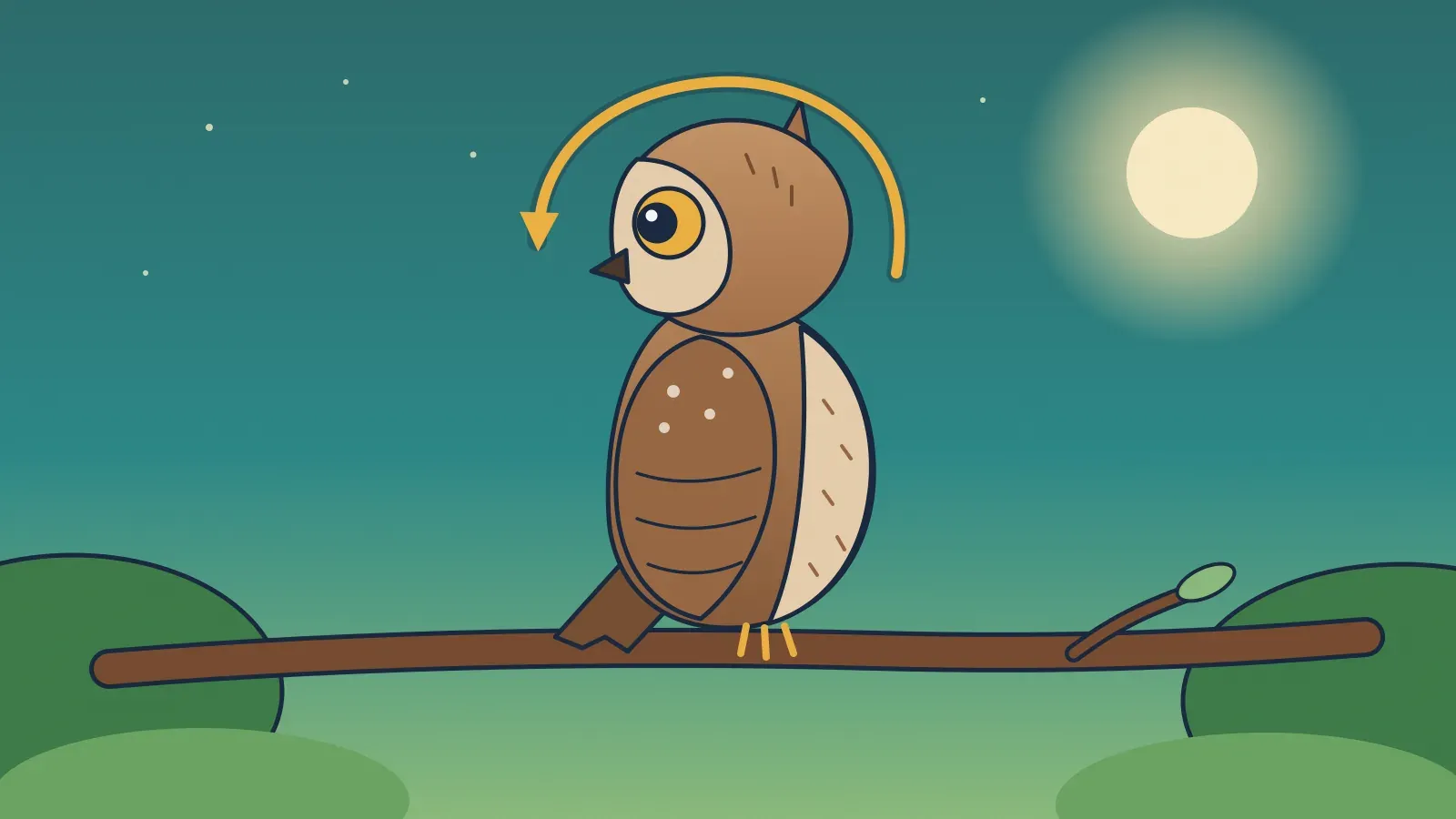
Owls can turn their heads up to about 270 degrees in either direction thanks to 14 neck vertebrae and blood vessels built not to pinch shut during the twist. They need that range because their eyes are fixed in their sockets: the only way for an owl to look somewhere else is to move its whole head.
Why do owls need to turn their heads so far?
Owl eyes are large for the size of the skull and shaped like tubes rather than balls, an adaptation linked to their excellent night vision. The trade-off is that they do not move in their sockets the way human and other mammal eyes do. To follow a rustling sound, keep an eye on a branch or track prey moving across a field, an owl has no choice but to turn its head.
It is worth clearing up a common myth: no owl spins its head a full 360 degrees. The limit is around 270 degrees each way, which is enough to look over a shoulder and behind its back. For comparison, the University of Illinois College of Veterinary Medicine puts a typical person's head rotation at roughly 160 to 180 degrees.
Is the real problem the bones or the blood?
An owl's neck has 14 cervical vertebrae, but the bigger puzzle was never how flexible the bones are. It was circulation. The arteries that carry blood to the brain and eyes run right through the neck, and twisting a tube full of blood is usually a terrible idea for any animal.
In people, the carotid and vertebral arteries are fairly fragile. Sudden head and neck movements, such as whiplash in a car crash, can tear the inner lining of these vessels and lead to clots and stroke. Owl arteries are delicate too. So how do they survive such extreme turns?
What did Johns Hopkins researchers find in 2013?
A team from the Johns Hopkins University School of Medicine, led by medical illustrator Fabian de Kok-Mercado and neuroradiologist Philippe Gailloud, examined about a dozen snowy, barred and great horned owls that had died of natural causes. They injected contrast dye into the blood vessels and used CT scans and angiography to trace where the blood went. These were the key adaptations they found:
- Roomy bone channels: in 12 of the 14 vertebrae, the holes the vertebral artery passes through are about 10 times wider than the artery itself, with air pockets that cushion the movement.
- A higher entry point: the vertebral artery enters the neck at the 12th vertebra instead of the 14th, as in other birds, which gives it extra slack.
- Blood reservoirs: at the base of the head, just under the jaw, the vessels widen and pool blood, keeping the brain and eyes supplied during a turn. Human arteries, by contrast, tend to get narrower as they branch.
- Bridges between arteries: small connections between the carotid and vertebral arteries, called anastomoses, let blood switch routes if one vessel gets squeezed.
The work was presented as an illustrated science poster. It won first place in the posters and graphics category of the National Science Foundation's 2012 International Science & Engineering Visualization Challenge and was highlighted in the journal Science in February 2013. It is an anatomical description of a small number of birds, not an experiment on living owls, but it helped explain how their circulation copes with the twist.
What does this tell us about the human neck?
The researchers themselves pointed out that humans lack most of these vessel-protecting features. So owls are not a model to copy: extreme twisting or forceful manipulation of the human head is dangerous precisely because our arteries have no equivalent slack, air cushions or reservoirs. In a human neck, for instance, the vertebral artery fits snugly inside its bony channels instead of floating in a roomy, cushioned space.
Every animal works around its physical limits in its own way. Cats twist their bodies in two sections to land on their feet, while an owl keeps its body still and turns only its head. And like other birds of prey, owls face hazards that people created, as the physics of why birds don't get electrocuted on power lines, and of when they sadly do, makes clear.
That head that seems to swivel around so effortlessly hides a neck full of slack, air cushions and emergency detours for blood. It is fine engineering in service of eyes that simply cannot move.