Why Cats (Almost) Always Land on Their Feet
A reflex that appears in the first weeks of life and a clever bit of physics let a cat flip over in midair with nothing to push against. But landing on its feet does not mean landing unhurt: falls from windows and balconies injure many cats every year.
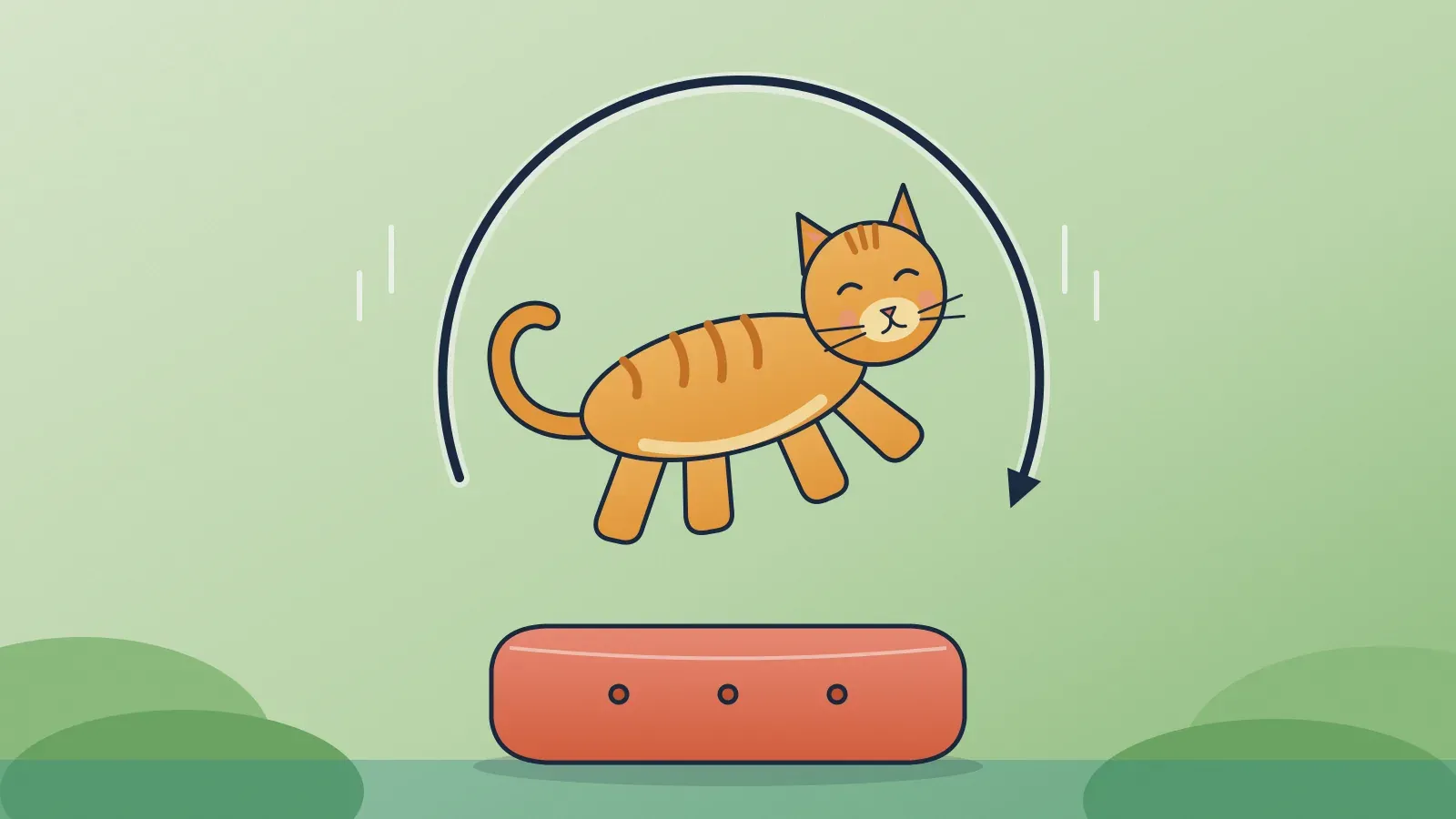
Drop a cat upside down from a reasonable height and it will almost certainly land on all fours. Behind it lies a sophisticated reflex and an elegant answer to a physics puzzle that baffled scientists in the late 19th century. There is also an important warning: landing on your feet is not the same as walking away unharmed.
A reflex that appears in the first weeks
The move has a name: the righting reflex. It starts to appear when a kitten is about 3 to 4 weeks old and is usually perfected between 6 and 9 weeks. It relies on the vestibular system, the part of the inner ear that senses balance and head orientation, and on vision. As soon as the cat senses it is upside down, its body launches an automatic sequence of movements.
The physics puzzle: turning with nothing to push on
In 1894, French scientist Étienne-Jules Marey photographed a falling cat using a technique called chronophotography, at 12 frames per second, and published the images in the journal Comptes Rendus. The pictures showed the animal was not rotating at the start of the fall, yet it ended up right side up. That ruled out the idea that it pushed off the hand that dropped it, and it created a riddle: under conservation of angular momentum, a body falling without spin should not be able to start spinning on its own in midair.
The answer is that a cat is not a rigid block. It bends in the middle and makes its front and back halves rotate around different axes, in opposite directions. Physics is respected, because the twists cancel each other out, but the end result is a rotation of the whole body.
- The cat bends its spine, so the front and back halves can move separately.
- It tucks its front legs and stretches its hind legs: the front turns a lot, up to about 90 degrees, while the back turns only slightly the other way.
- Then it switches: front legs out, hind legs in, and now the back half catches up with the front.
- If needed, it repeats the cycle until it completes the half turn, then readies its legs for impact.
Height matters, and falls always hurt
The most cited study on the subject was published in 1987 in the Journal of the American Veterinary Medical Association. It looked at 132 cats treated at the Animal Medical Center in New York after falling from buildings. About 90% survived, but many had serious injuries. The authors noted that injuries increased with height up to the seventh floor and then decreased, and suggested that after several floors a cat reaches terminal velocity, relaxes and spreads out, which would distribute the impact better.
That conclusion is disputed. Cats killed on the spot were rarely brought to a vet and so were never counted, a bias that can make higher falls look less dangerous than they are. A 2003 study of 119 cats linked falls from the seventh floor or higher to more severe injuries. Short falls are risky too: a cat may not have time to finish turning, and injuries have been reported from second-floor falls.
The most common injuries
Veterinarians call this pattern high-rise syndrome. According to US animal hospitals and animal welfare groups, the most frequent injuries include broken jaws and teeth, chest and lung injuries, fractured legs and pelvis, and internal bleeding. Some of these problems do not show right away, so a cat that has fallen from any significant height should see a veterinarian immediately, even if it seems fine.
How to protect your cat
Cats have little fear of heights, get distracted by birds and insects, and can grip tree bark but not smooth concrete or aluminum ledges. Veterinarians and animal welfare groups recommend sturdy, well-fitted screens or safety nets on every window, balcony and terrace a cat can reach. Childproof window guards are not enough, because a cat can slip between the bars. Windows without screens should stay closed.
In short: a cat lands on its feet thanks to a reflex that forms in its first weeks and a flexible body that turns in two parts without breaking any law of physics. But that skill only guarantees the landing position, not a safe landing. Screens on windows and an eye on balconies protect a cat far better than any reflex.