Why Do Zebras Have Stripes? What Science Knows So Far
Scientists have argued about the purpose of zebra stripes for more than 150 years. Today the explanation with the most experimental support is protection from biting flies, but camouflage, temperature and recognition are still part of the debate.
Few animals are as easy to recognize as a zebra. Oddly, for something so conspicuous, the black-and-white pattern still has no final explanation. Researchers have studied the question for more than 150 years, and many hypotheses have been put forward. In recent years, though, one of them has gathered far more evidence than the rest.
An old question with several possible answers
The ideas fall into four broad groups: protection from insects, defense against predators, temperature control and communication among zebras themselves. They are not necessarily mutually exclusive, and stripes may well serve more than one purpose. The table sums up where each hypothesis stands.
| Hypothesis | What the studies say |
|---|---|
| Biting flies | Best supported: geographic correlation and favorable field experiments |
| Camouflage from predators | Little support: lions and hyenas can barely make out stripes at a distance |
| Temperature control | Debated: linked to heat, but one experiment found no cooling |
| Social recognition | Little direct evidence so far |
Flies: the best-supported hypothesis today
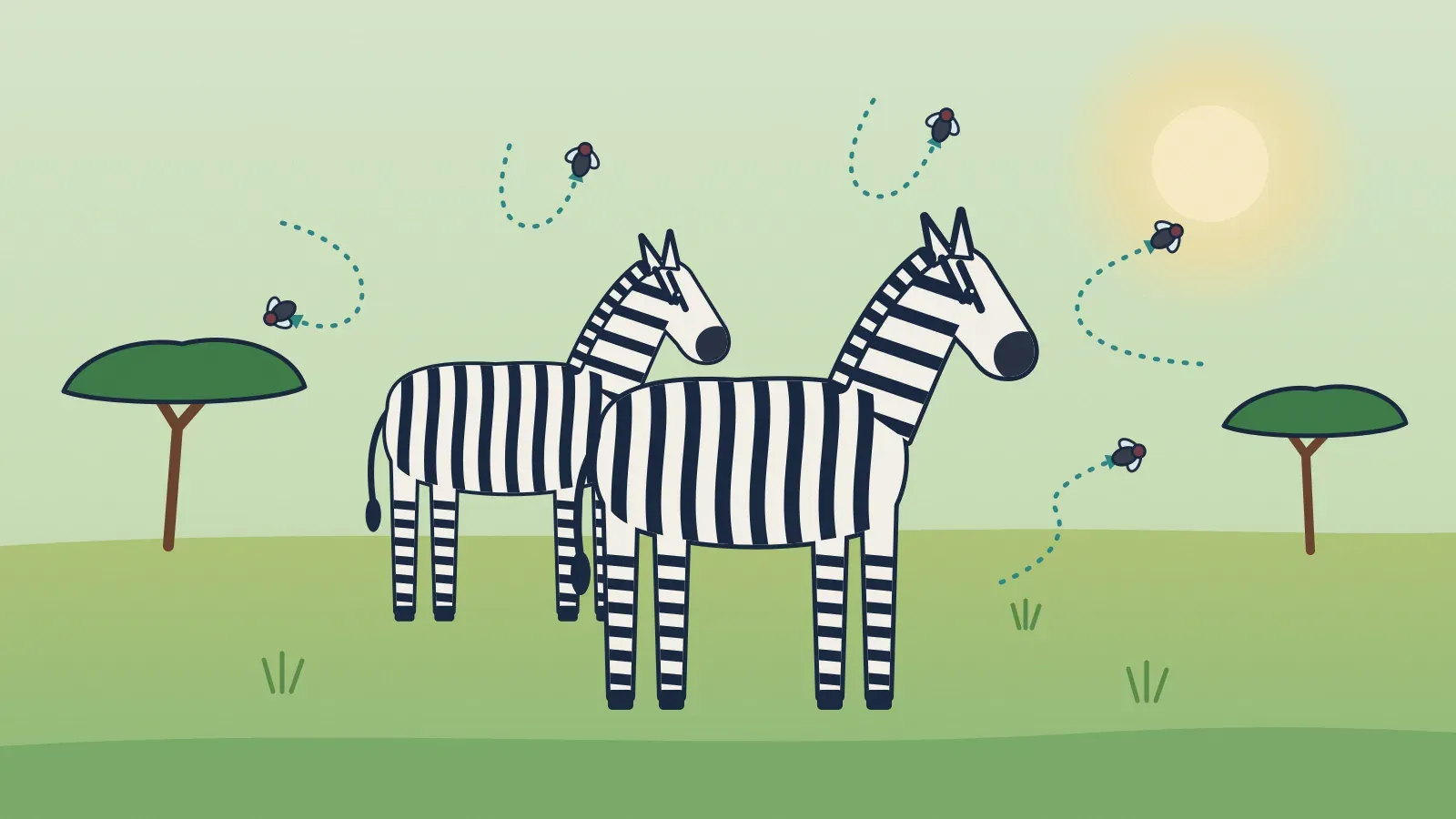
In 2014, a team led by biologist Tim Caro of the University of California, Davis, published an analysis in Nature Communications comparing the ranges of seven species of equids, including zebras, horses and asses, and their subspecies, with how strongly striped they were in each region. The researchers tested five explanations and only one fit well: stripes were stronger where biting flies such as horseflies were more of a nuisance. They also noted that zebra hair is shorter than the mouthparts of these flies, which would make zebras an easy target.
In 2019, researchers from the University of Bristol and UC Davis filmed horseflies around zebras and horses at a livery in England. Flies circled both animals equally often, but they failed to slow down as they approached zebras and so landed on them far less. Horses wearing striped coats also got fewer landings than horses in single-colored coats. The same year, a Japanese study of six cows painted with black and white stripes recorded close to half as many horsefly bites as on unpainted animals.
The exact mechanism is still unclear. One possibility is that stripes confuse the flies' low-resolution vision as they try to land. Even so, among all the hypotheses, this is the one with the largest body of supporting data today.
Camouflage and predators
One long-standing idea is that stripes help hide zebras or confuse lions during an attack. A 2016 study in PLOS ONE calculated the distance at which lions and hyenas can make out the stripes. The result: about 50 meters (164 feet) by day, 30 meters (98 feet) at twilight and only 9 meters (29 feet) on moonless nights. By the time a predator is close enough to see the stripes, it has probably already heard or smelled its prey. The authors concluded the data do not support a camouflage role.
Temperature: a clue still under debate
Another hypothesis holds that black and white bands, which absorb heat differently, might help cool the body. In 2015, a study of 16 plains zebra populations published in Royal Society Open Science found bolder stripes in hotter places, and temperature was the factor most closely tied to the pattern. But a 2018 Hungarian and Swedish experiment covered water-filled barrels with hides of various colors and left them in the sun: the striped barrel stayed no cooler than a gray one. The question remains open, not least because hot regions also tend to have more flies.
Recognition among zebras
Each zebra's stripe pattern is often described as unique, which has led to the suggestion that it helps zebras recognize one another or keep the herd together. So far, however, there is no strong evidence that this is the main function. The 2016 study on predator vision, for example, also found no sign that stripes help with recognition at a distance.
In short: there is no absolute consensus, but the scales tip toward flies. Protection from biting insects is the only hypothesis backed by both geographic patterns and favorable field experiments, while camouflage, temperature and recognition have weak or conflicting support. Whenever you read that science has solved the zebra mystery, remember that research is still under way.