The Honeybee Waggle Dance: How Bees Give Directions to Food
Back at the hive, a honeybee uses a dance to signal the distance and direction of a food source, with the sun as its reference point. The discovery earned Karl von Frisch the 1973 Nobel Prize.
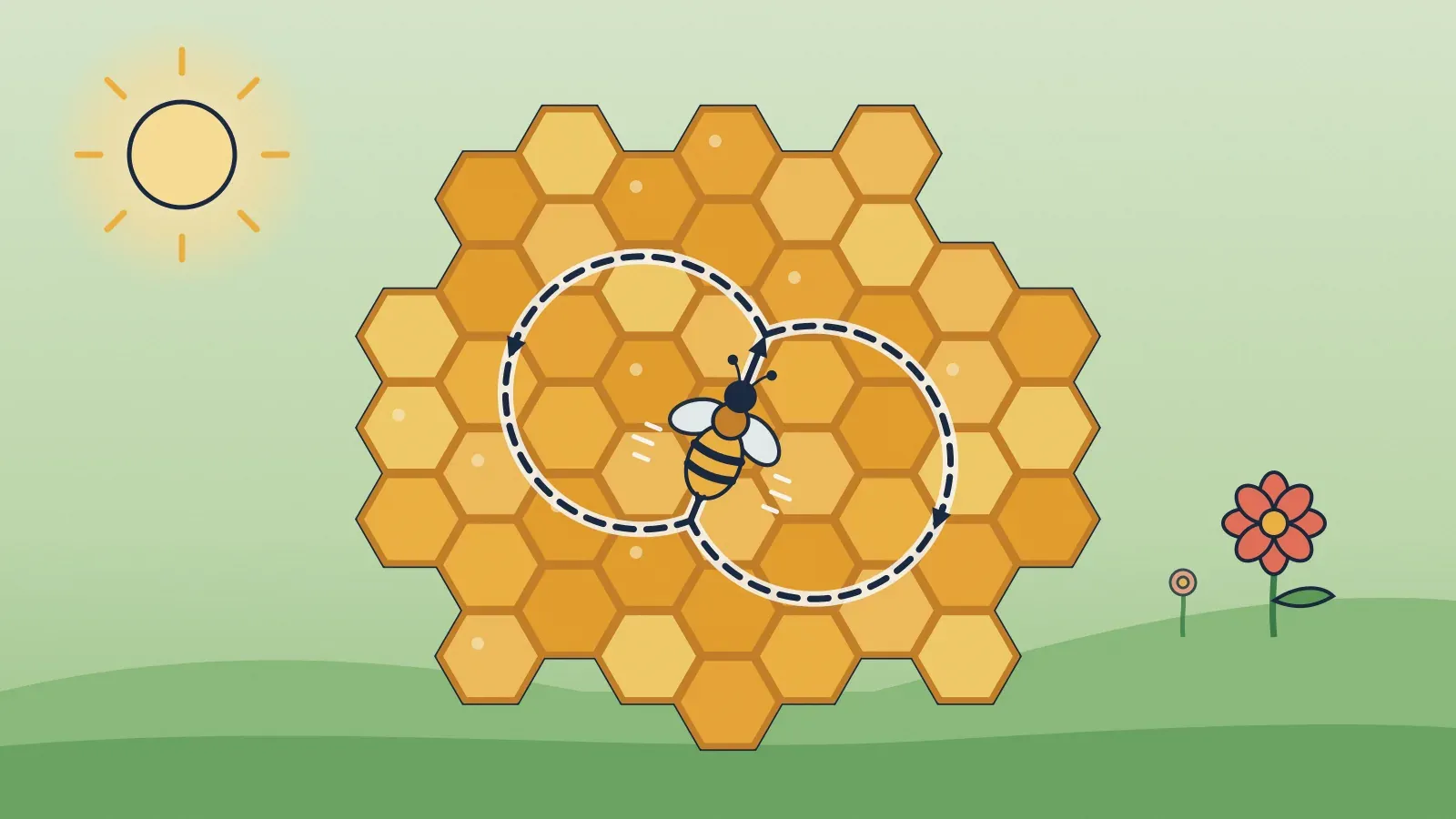
A honeybee that finds a good patch of flowers does not keep it to herself. Back at the hive, in the dark and on the vertical surface of the comb, she performs a series of moves that her nestmates follow closely. Those moves work like a map: they say whether food is near or far and, for more distant sources, which way to fly.
Karl von Frisch and the 1973 Nobel Prize
The code was cracked by Austrian zoologist Karl von Frisch, born in Vienna in 1886 and died in Munich in 1982. He watched paint-marked bees in glass-walled observation hives, which let him see every dance. The first version of his theory, published in 1923, was wrong: he believed one dance signaled nectar and the other pollen. The famous interpretation, linking the dances to distance and direction, was worked out in the 1940s. In 1973, von Frisch shared the Nobel Prize in Physiology or Medicine with Konrad Lorenz and Nikolaas Tinbergen for discoveries concerning the organization and elicitation of individual and social behavior patterns.
The round dance: food close by
When food is very close to the hive, the bee performs the so-called round dance: she runs in small circles, reversing direction now and then. The exact cutoff depends on the source, from about 50 meters (165 feet) in some references to around 100 meters (330 feet) in others. In the classic description, this dance only announces that food is nearby, without giving a direction. Recruits then head out and search, guided in part by the floral scent left on the dancer's body.
The waggle dance: distance and direction
For more distant sources, the waggle dance takes over. The bee walks in a straight line while shaking her abdomen from side to side, loops back in a semicircle to one side, repeats the straight run and loops back on the other side, tracing something like a figure eight. The length of the straight run encodes distance: the farther the food, the longer the waggle. Outreach material from the University of Sussex gives a rough guide of 1 second of waggling per kilometer (about 0.6 miles), but the calibration varies between colonies and landscapes.
That is because a bee does not measure distance in meters but by how much scenery streams past her eyes during the flight. An experiment published in Nature in 2001 showed that bees collecting food inside a short, narrow tunnel danced as if the source were much farther away.
The sun as a compass
The cleverest part is direction. Inside the dark hive, the bee dances on the vertical comb and uses gravity as her reference. The angle between the straight run and the vertical matches the angle between the sun's direction and the path to the food. Because the sun moves across the sky, the same source is signaled at different angles in the morning and the afternoon. Sounds made during the waggle run help followers pick up the message in the dark.
| Straight run on the comb | Where the food is |
|---|---|
| Straight up | Toward the sun |
| Straight down | Directly away from the sun |
| 60 degrees left of vertical | 60 degrees left of the sun |
| 90 degrees right of vertical | 90 degrees right of the sun |
What science has refined since then
Von Frisch's ideas remain the foundation of the field, but some details have been refined. A study published in 2008 in the journal Animal Behaviour concluded that the round dance and the waggle dance are not two fully separate dances: both carry some information about distance and direction, and there is no sharp switch between them. The authors suggest they are the two ends of a single, adjustable signal. It is also known that dance intensity reflects the quality of the source and that, on the final stretch, recruits rely heavily on scent to find the flowers.
In short: a dancing bee is translating a journey into movement. The shape of the dance says whether food is close, the length of the waggle says how far, and the angle from vertical says which way, with the sun as the reference point. Next time you see bees working the same flowers, remember that many of them may have arrived by following a nestmate's directions.