Why Does Hair Turn Gray? Genes, Age and What Stress Really Does
A white hair is a hair with no melanin. It appears when the follicle stops replacing its pigment-making cells, on a schedule set mostly by genes and age. The role of stress is still being worked out.
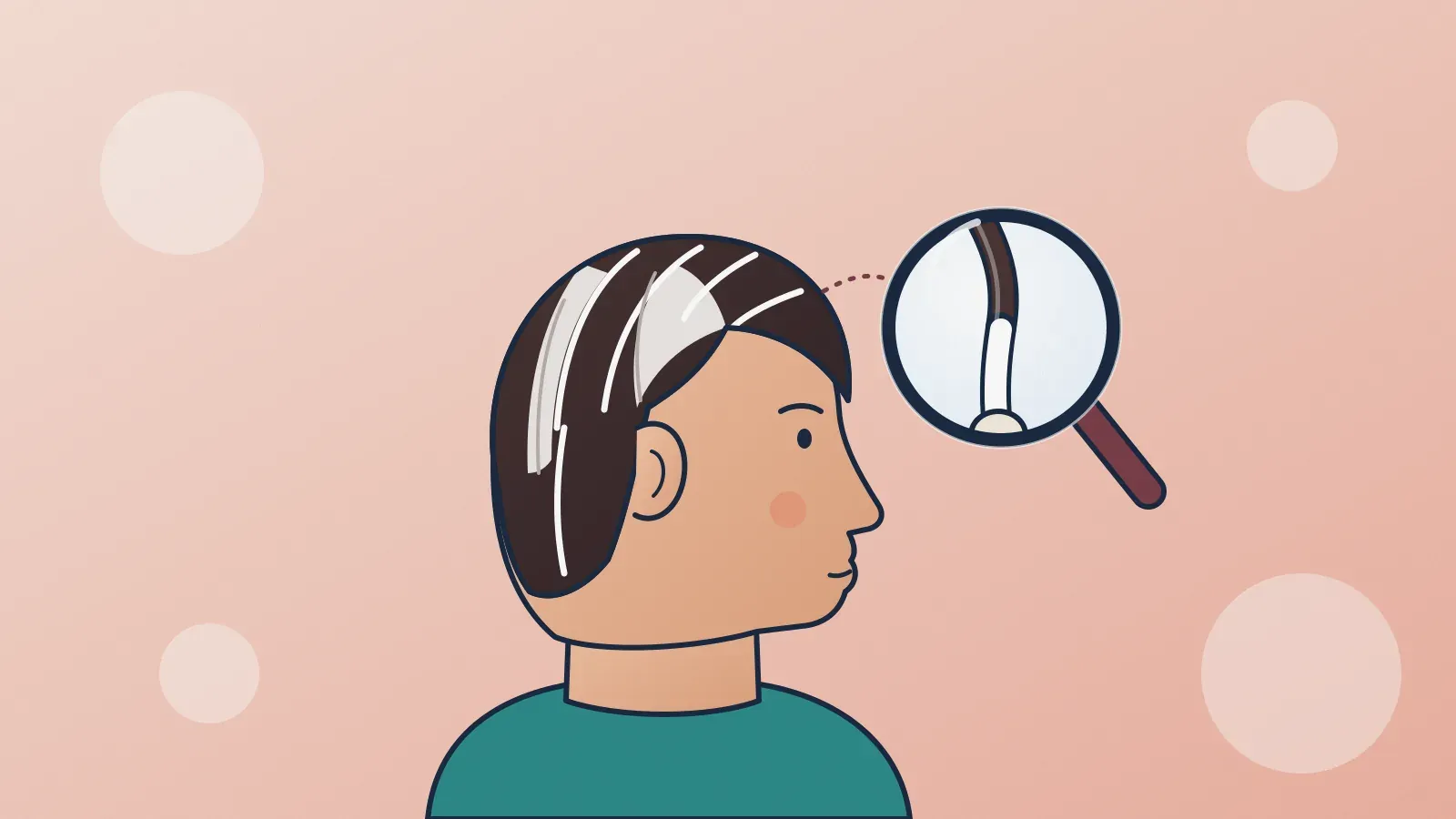
Hair turns gray when new strands stop receiving melanin, the pigment that gives them color. Melanin is made by cells called melanocytes at the base of each follicle, and those cells are replaced from a reserve of stem cells. As the years go by, that system runs down, and new hairs grow in with no pigment at all.
If a hair has no color, why does it look white?
There is no such thing as white pigment in hair. What we call a white hair is simply a hair without melanin. With nothing to absorb part of the light, it reflects or lets through almost all of the light that hits it, so it looks pale, sometimes almost translucent up close.
Gray hair is usually a mix: pigmented strands next to unpigmented ones, plus some with only a little melanin. From a distance, the eye blends them into gray. As the share of unpigmented strands grows, the overall look moves from salt-and-pepper to white.
This pigment is made inside the body. That is a different story from flamingos, which get their pink color from their food: in human hair, color depends on living cells working at the root of every strand.
What happens inside the follicle?
Every hair grows from a follicle, a tiny pocket in the skin. At its base, melanocytes produce melanin and pass it to the cells that build the hair as it grows. Because hair goes through cycles of growth, shedding and regrowth, those melanocytes have to be renewed with each new cycle.
The renewal comes from melanocyte stem cells stored in the follicle itself. In each cycle, some of them become pigment-producing cells while others stay in reserve. When the reserve runs out or stops working properly, the follicle keeps making hair, just without color. The part of a hair that has already grown does not fade: color is set at the root as each section forms.
At what age does gray hair usually start?
Timing varies a lot from person to person and between populations. A 2021 review in the Journal of Clinical and Aesthetic Dermatology summarizes the average age of onset like this:
| Group | Average onset of gray hair |
|---|---|
| White (Caucasian) people | Mid-30s |
| People of Asian descent | Late 30s |
| People of African descent | Mid-40s |
The same review mentions the old 50-50-50 rule: by age 50, about half of people would have about half of their hair gray. It is a traditional rule of thumb, not a law, and ethnic and geographic background shift the pace considerably. Graying is considered premature when it starts before 20 in white people, 25 in Asian people and 30 in African people.
Do your genes decide when you go gray?
Largely, yes. In 2016, a study in Nature Communications led by University College London analyzed DNA from more than 6,000 volunteers in Brazil, Colombia, Chile, Mexico and Peru. For the first time, a gene was linked to graying: IRF4, already known to help regulate the production and storage of melanin.
The authors stressed that IRF4 does not act alone. It is one piece among other factors, some not yet identified, which helps explain why siblings can go gray at different ages.
Can stress really turn your hair gray?
This is the most famous part of the story and the most often oversimplified. In 2020, Harvard researchers led by Ya-Chieh Hsu published a mouse study in Nature. Under stress, nerves of the sympathetic system, which drives the fight-or-flight response, released norepinephrine next to the follicles. The melanocyte stem cells all turned into pigment cells at once, and the reserve was used up within days. The damage was permanent.
It is the same branch of the nervous system that makes your hair stand on end when you get goosebumps. But what holds for mice does not automatically hold for people.
In 2021, a Columbia University team led by Martin Picard published an analysis in eLife of hairs from 14 volunteers, sliced finely to reconstruct each strand's history, and compared the results with stress diaries. Stressful periods lined up with white segments. And some hairs regained their color when stress eased, including several from one participant during a vacation.
The study was small and shows an association, not proof of cause. The authors think stress only tips hairs that were already close to a threshold, which is more common in middle age, and they do not expect a calmer life to darken hair that has been gray for years.
For now, there is no proven way to prevent or reverse gray hair. Each white strand marks the moment a follicle stopped replacing its pigment, a story written mostly by genes and age, with perhaps a small contribution from life's harder stretches.
Sources
- Journal of Clinical and Aesthetic Dermatology: Hair Aging in Different Races and Ethnicities
- University College London: First gene for grey hair found
- Harvard Gazette: New findings suggest how stress may trigger gray hair
- Columbia University Irving Medical Center: It's True: Stress Does Turn Hair Gray (And It's Reversible)