Who Invented Ice Cream? The History, Separated From the Legends
Ice cream has no single inventor. Snow-chilled drinks go back to antiquity, but true ice cream depended on the ice-and-salt technique described in Europe in the 16th century. Marco Polo and Catherine de' Medici belong to the legends.
No single person invented ice cream. Ancient peoples chilled drinks and syrups with snow, but freezing a sweet cream required surrounding the container with ice and salt. That method was described in Europe around 1550, and the first European ice creams appeared in Italy in the 17th century. There is no proof Marco Polo had any part in it.
Ice cream's history is full of famous names that vanish when you check the documents. So it helps to split the question in two: who enjoyed cold treats, and who actually managed to freeze a sweet mixture.
Did ancient people eat ice cream?
Not exactly. They enjoyed drinks and sweets chilled with snow or ice, which is a different thing. According to National Geographic, around 400 B.C. sharbat, a syrup cooled with snow, was a popular treat in the Persian Empire. HISTORY notes that snow was sold in the streets of Athens in the fifth century B.C. and that Tang dynasty texts in China describe a sweet drink of iced water buffalo milk.
There is also a story that the Roman emperor Nero sent for mountain snow to chill fruit juices with honey. The University of Guelph's ice cream technology e-book in Canada treats that episode as folklore: repeated for centuries, but hard to confirm.
Why did ice and salt matter so much?
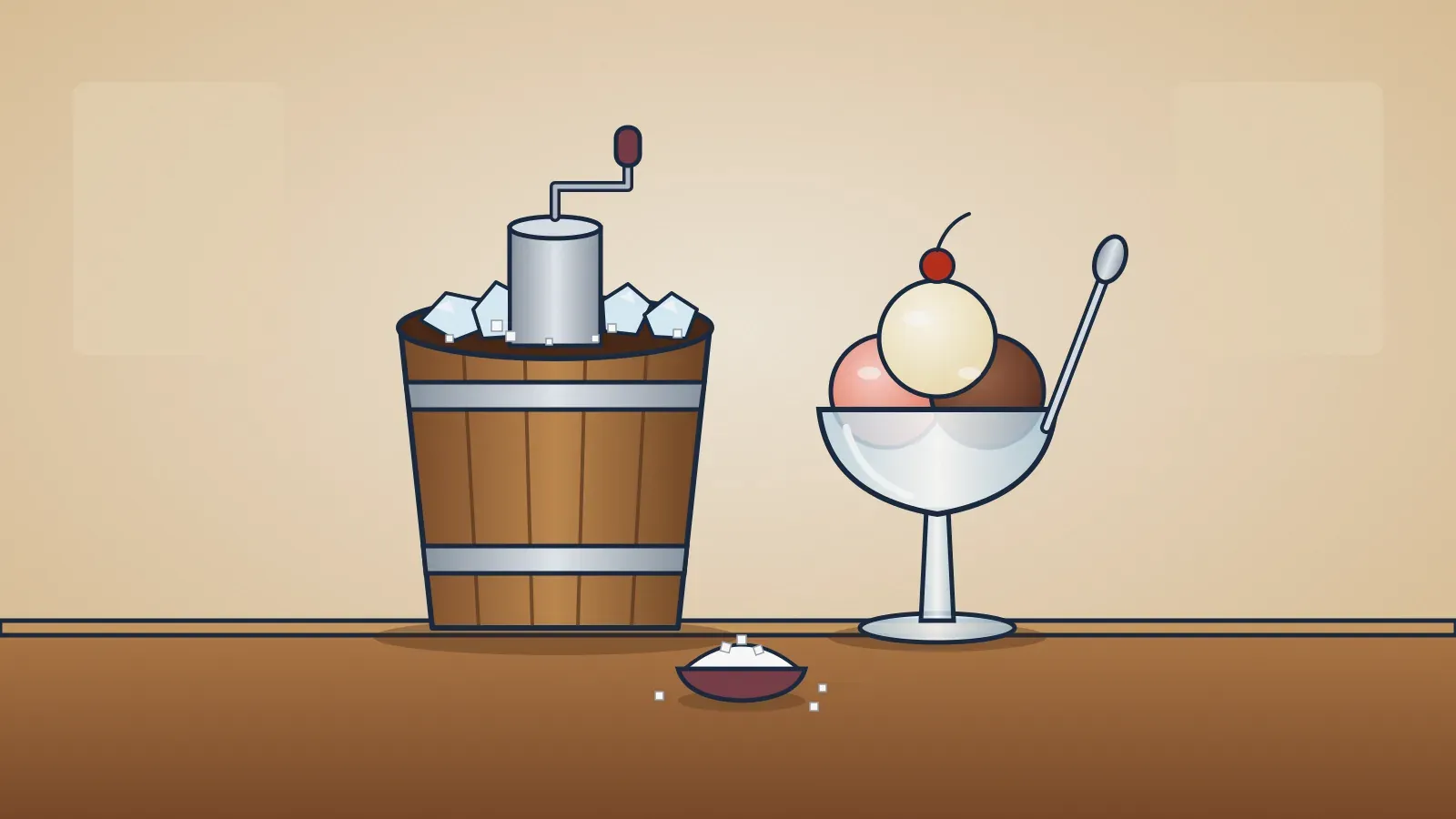
This was the real technical leap. Plain snow chills, but it cannot freeze a mix of milk, sugar and fruit. When salt is added to ice, the ice melts into a brine that is much colder than ordinary ice, below 32 °F (0 °C). A metal container set in that brine and stirred constantly freezes its contents with small crystals and a creamy texture.
HISTORY says this know-how was familiar in the Arab world from the 13th century. In Europe, according to National Geographic, the first evidence is a treatise published in 1550 by Blas de Villafranca, a Spanish doctor living in Rome. In 1558, Giambattista della Porta of Naples described the method in his book Magia naturalis, using it to freeze wine. The sources do not agree on every date, but all of them tie true ice cream to this technique.
Which parts of the ice cream story are legends?
Three stories show up in almost every article on the subject, and none holds up well against the records:
- Marco Polo: he supposedly brought recipes for milk ices back from China in the 1290s. National Geographic notes that some historians accept the idea and others call it a myth; the Guelph e-book cites researchers who found no historical evidence for it.
- Catherine de' Medici: the legend says her Italian cooks brought ice cream to France when she married the future king in 1533. No record confirms it.
- Charles I of England: he supposedly paid his cook to keep a frozen cream recipe secret. There are no records of any such payment either.
Legends like these are common in food history. The same thing happened with the English nobleman said to have named the world's most famous snack, as the origin of the sandwich, fact and legend shows.
When did ice cream spread through Europe and America?
The first European ices made with this technique were probably made in Italy in the early 1600s. In 1690, a whole book on sorbetti appeared in Naples, and between 1692 and 1694 Antonio Latini, steward to the Spanish viceroy of Naples, published frozen dessert recipes, including a milk sorbet with candied pumpkin. In England, ice cream was served at a Windsor banquet in 1671. In France, the first book devoted entirely to ice cream came out in 1768.
In America, ice cream shows up in colonial-era records. In 1774, the caterer Phillip Lenzi advertised ice cream for sale in a New York newspaper, and George Washington spent about $200 on ice cream in the summer of 1790. Until then, though, making it took hours, stirring a metal pot by hand inside a bucket of ice and salt.
| Year | Milestone |
|---|---|
| 1550 | First European description of the ice-and-salt technique |
| 1671 | Ice cream served at a banquet in Windsor |
| 1690 | Book on sorbetti published in Naples |
| 1843 | Nancy Johnson patents the hand-cranked freezer |
| 1851 | Jacob Fussell opens the first ice cream factory, in Baltimore |
Two 19th-century developments made ice cream popular. In 1843, Nancy Johnson patented a hand-cranked freezer whose paddles scraped and blended the mix inside a pail packed with ice and salt. According to the Smithsonian, it was the first U.S. patent for an ice cream appliance. In 1851, Jacob Fussell, a Baltimore milk dealer, opened the first ice cream factory.
How does ice cream connect to other food stories?
Ice cream shares a path with chocolate, which came from the cacao of the Americas: both began as luxuries for a few and only became everyday treats with industry. And for anyone who eats it too fast, it still carries a well-known side effect: brain freeze.
In the end, credit for ice cream is shared: Persians and Chinese with their chilled treats, scholars who described the ice-and-salt trick, Italian cooks, and an American inventor who swapped hours of arm work for a crank.