Why Are Traffic Lights Red, Yellow and Green? The Answer Runs on Rails
Traffic light colors were inherited from 19th-century railroads, where red already meant danger. The first road signal appeared in London in 1868, and yellow only joined the set in the United States in 1920.
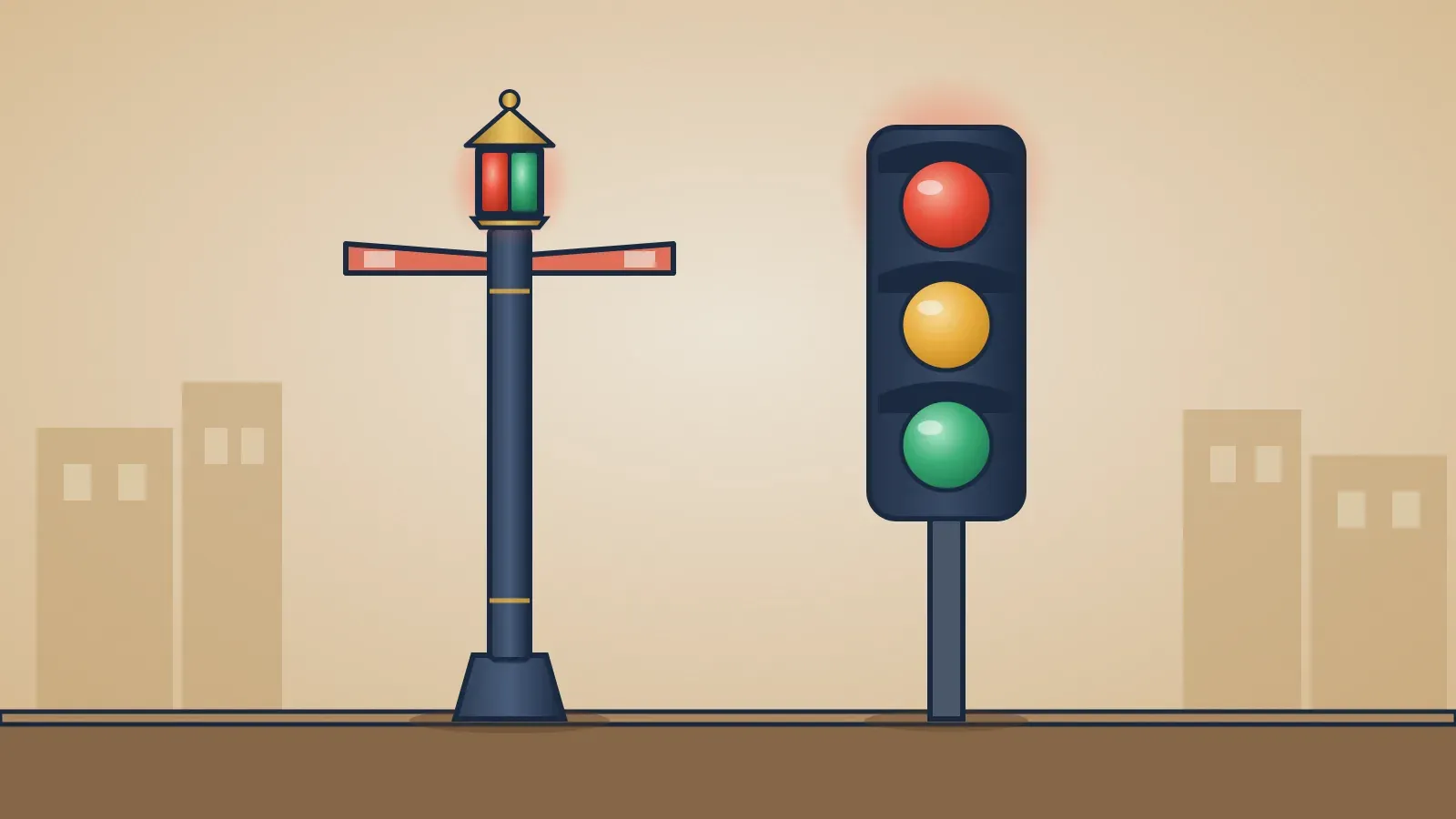
Traffic lights are red, yellow and green because they inherited their colors from 19th-century railroad signals. On the rails, red already meant stop or danger. Green came to mean go after white proved confusing, and yellow became the caution signal. When street signals arrived, they simply borrowed that code.
So the choice did not come from a study of human vision or a meeting of traffic engineers. It was handed down from one form of transport to another, with false starts, an explosion and plenty of arguments over who did what first.
Where did signal colors come from?
Before cars, trains were the ones that needed light signals. According to the Bullock Texas State History Museum, early railroad signals used white to show it was safe to proceed, green for caution and red for stop or danger. Railroad workers carried lanterns with glass in those colors.
White had a serious flaw, though. As cities grew, streetlights were also white, and a signal lantern could be mistaken for any other lamp. Railroads changed the code: green came to mean proceed, and yellow or orange took over as the caution color. That trio is the direct ancestor of the modern traffic light.
What was the first traffic light like in 1868?
The world's first traffic signal went up in London in December 1868, at the junction of Great George Street and Bridge Street, outside the Houses of Parliament. It was designed by John Peake Knight, a railway manager from Nottingham, and copied the semaphore signals used at rail crossings.
- By day, colored arms on a post about 20 feet (6 m) high changed position: horizontal meant stop, tilted meant proceed with caution.
- At night, gas lamps showed red for stop and green for go.
- A police officer worked the device by hand.
The experiment did not last. Less than a month after it was installed, a leak in the gas line feeding the lamps caused an explosion that badly burned the officer operating the signal. The idea was dropped, and light signals only spread across Britain in the 1920s, by then electric and inspired by American designs.
When did electric traffic lights appear?
Electricity solved the gas problem, and the United States became the testing ground for new signals in the early 20th century. Sources disagree about who came first, because several cities tried similar ideas at almost the same time.
In 1912, according to Smithsonian Magazine, Salt Lake City police officer Lester Wire wired red and green lights to the trolley lines. On August 5, 1914, Cleveland tested an electric signal from the American Traffic Signal Company, designed by James Hoge, at Euclid Avenue and East 105th Street. It had only two colors, red and green, plus bells that rang when traffic could move.
Yellow arrived in 1920, in Detroit. Police officer William L. Potts created the first three-color signal facing all four directions of an intersection, installed at Woodward Avenue and Fort Street. According to The Henry Ford museum, which holds the device, three-color signals became standard by the mid-1930s.
| Year | Place | What was new |
|---|---|---|
| 1868 | London | Semaphore arms plus red and green gas lamps |
| 1912 | Salt Lake City | Electric red and green lights wired to trolley lines |
| 1914 | Cleveland | Two-color electric signal tested on August 5 |
| 1920 | Detroit | First three-color, four-way signal |
Why red for stop?
The historical answer is tradition: red was already the danger color on the railroads, and road traffic kept the code that engineers and drivers already knew. Carriage drivers, and later motorists, did not have to learn anything new: they inherited a language that the railways were already using every day.
A physical explanation is also often mentioned: red light scatters the least in air, the same physics behind why the sky is blue and sunsets glow orange. That may help the color stand out at a distance, but the records show the choice came from the rails, not from an optics calculation.
What do traffic lights have in common with other conventions?
The traffic light is a good example of a standard that wins by getting there first. Once millions of drivers have learned the code, changing it would cost more than keeping it. The same logic helps explain why keyboards use QWERTY instead of alphabetical order.
There is an irony worth remembering: London's signal, meant to protect people crossing the street, claimed as its first casualty the very officer who ran it. It took swapping gas for electricity, and half a century of tinkering, before red, yellow and green became the shared language of street corners.