What Is Compound Interest? How "Interest on Interest" Adds Up
Compound interest is charged or earned on both the principal and the interest already added. See a worked example against simple interest, the Rule of 72 and why the same math applies to debt.
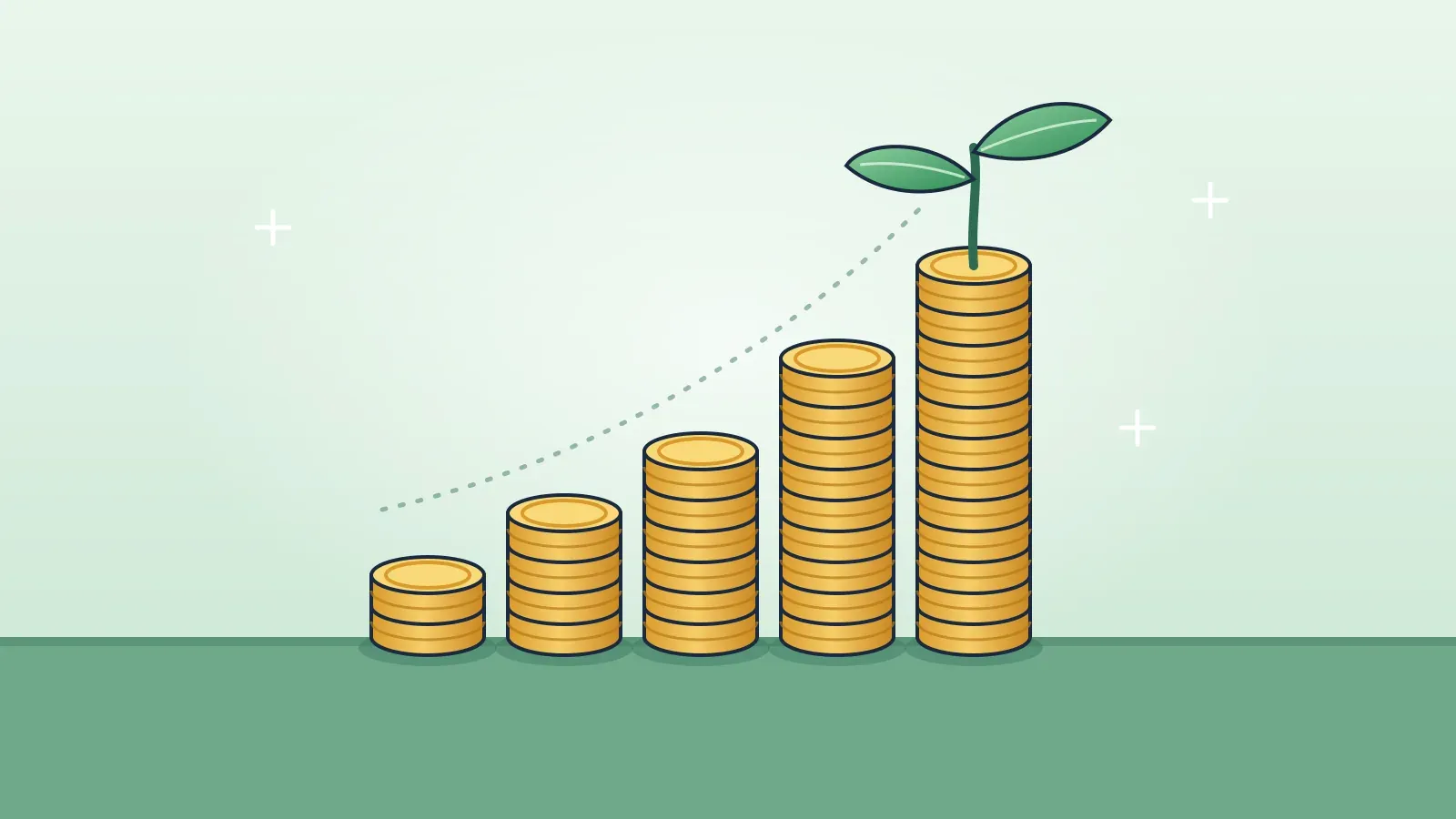
Compound interest is interest calculated on the original amount and also on the interest already added to it. Each period, whatever was earned, or owed, becomes part of the base for the next calculation. That is why the total grows faster and faster, whether it is a savings balance or a debt.
People often sum it up as "interest on interest." The idea fits in one sentence, but its effect over time is easy to underestimate, which is exactly where most mental math goes wrong.
How is compound interest different from simple interest?
With simple interest, the rate is always applied to the original principal, so every period adds the same amount: total = principal × (1 + rate × number of periods). With compound interest, each period's interest is added to the principal, and the next period is calculated on that new total: total = principal × (1 + rate) raised to the number of periods.
The U.S. Consumer Financial Protection Bureau (CFPB) uses a simple illustration: $1,000 at 5% a year, compounded once a year, becomes $1,050 after one year. In the second year, the 5% applies to $1,050, adding $52.50, for a total of $1,102.50.
To make the gap easier to see, here is a hypothetical example with a round rate: $1,000 at 10% a year, with no deposits or withdrawals. The rate is purely illustrative and does not represent any real account or investment.
| After | Simple interest (10% a year) | Compound interest (10% a year) |
|---|---|---|
| 1 year | $1,100.00 | $1,100.00 |
| 2 years | $1,200.00 | $1,210.00 |
| 3 years | $1,300.00 | $1,331.00 |
| 5 years | $1,500.00 | $1,610.51 |
| 10 years | $2,000.00 | $2,593.74 |
| 20 years | $3,000.00 | $6,727.50 |
Why does the gap grow so much over time?
Simple interest grows in a straight line: the same amount is added every year. Compound interest grows exponentially: the balance is multiplied by the same factor every year. After twenty years in the example above, the compound balance is more than double the simple one.
Exponential growth is hard to picture. In a 2016 financial skills survey run by the Banco de España and Spain's securities regulator, the CNMV, adults were asked how much 100 euros would be worth after five years at a fixed 2% a year. The right answer was "more than 110 euros" (about 110.41). Only 46% got it right; 44% answered incorrectly and 10% said they did not know. The same kind of shortcut that makes prices ending in 99 look cheaper leads people to imagine steady addition where there is multiplication.
What is the Rule of 72?
It is a shortcut for estimating how long it takes money to double with compound interest: divide 72 by the interest rate in percent. At 10% a year, 72 ÷ 10 = 7.2 years; the exact answer is about 7.27. At 6% a year, the rule gives 12 years, and the exact figure is close to 11.9.
A guide from New Mexico State University's Arrowhead Center describes it as a rule of thumb, not an exact law: it works fairly well for rates between roughly 1% and 12% and becomes less accurate outside that range. It comes from the compound interest formula itself. The natural logarithm of 2 is about 0.693, which is why some people use a "Rule of 70"; 72 is popular because it gives good estimates and divides evenly by many numbers.
What happens when compound interest works against you?
The mechanism does not change when money is borrowed. If a debt goes unpaid, one month's interest becomes part of the balance and starts generating interest the following month. The Banco de España notes that ignoring this effect leads people to underestimate the cost of debt.
Another hypothetical example: a $1,000 debt at 5% a month, with no payments at all.
- With simple interest, the balance after 12 months would be $1,600.00.
- With compound interest, it reaches about $1,795.86.
- By the Rule of 72, the debt doubles in roughly 72 ÷ 5 = 14.4 months; the exact answer is close to 14.2 months.
The rule works with any unit of time: plug in a monthly rate and the answer comes out in months. How often interest is added also matters. According to the CFPB, more frequent compounding, a higher rate or a larger principal all make a balance grow faster.
Does compound interest always beat simple interest?
Not quite. There is a curious exception: over a span shorter than one compounding period, simple interest actually comes out slightly ahead. At exactly one period the two are equal, and only after that does compounding pull away. In the 10% example, both give $1,100 at the end of year one; by year two the difference is $10, and by year twenty it is more than $3,700.
Rising prices also change how these numbers should be read. A balance that grows 10% in a year when everything costs 10% more buys the same as before, which is why it helps to understand what inflation is and why prices rise.
In the end, compound interest is neutral arithmetic. The same multiplication that makes a forgotten savings balance quietly grow makes a forgotten debt swell at the same pace; time and the direction of the money decide which side of the equation you are on.