Where Did Money Come From? The Barter Myth, Debt and the First Coins
Anthropologists have never found an economy based purely on barter. The oldest records point to accounts and credit in Mesopotamia; coins came later in Lydia, and paper money in China.
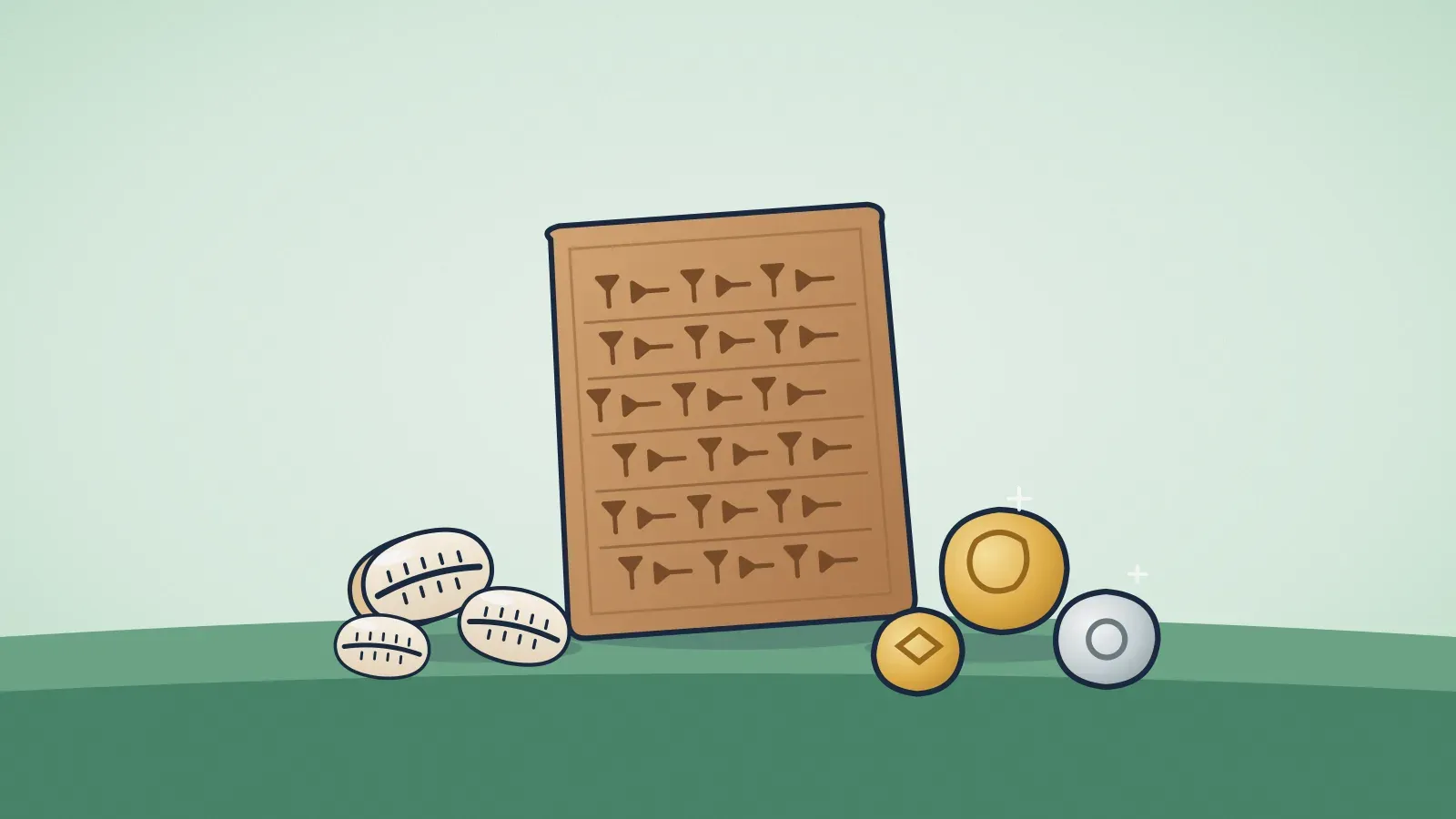
Money has no single inventor, and it probably did not grow out of barter either. The oldest records show accounts and debts kept by temples and palaces in Mesopotamia around 3200 BCE. Metal coins arrived much later, roughly 2,600 years ago in the kingdom of Lydia, and paper money first appeared in China.
Is the barter story true?
Most textbooks tell the same tale. In the beginning, people swapped goods directly: fish for shoes, wheat for wool. But barter needs an awkward coincidence, because the person with fish has to find someone who has shoes and also wants fish. To escape that problem, communities supposedly settled on one commodity everyone would accept, and money was born.
The Scottish economist Adam Smith popularized this account in the 18th century. He pictured a baker and a butcher who cannot trade because neither wants what the other has, and concluded that no exchange can be made between them. From there, the story became the standard opening chapter of economics.
The trouble began when anthropologists went looking for these barter economies. In a 1985 paper, anthropologist Caroline Humphrey summed up the result: no example of a barter economy, pure and simple, has ever been described, let alone the emergence from it of money. All available ethnography, she added, suggests there never has been such a thing.
If not barter, what came first?
American anthropologist David Graeber, author of a 2011 book on the history of debt, argued that credit came before coins. In an interview republished by Brazil's Instituto Humanitas Unisinos, he pointed to Mesopotamian archives showing, around 3200 BCE, an elaborate system of money accounts and complex credit arrangements.
Those records came from huge, bureaucratic temples and palaces that managed land, herds and workshops. In that setting, money worked first as a unit of account: a shared yardstick for what things were worth and how much each person owed, written on clay tablets. The idea is simple but powerful. Money does not need a coin changing hands; it needs a standard of value and someone keeping track of debts until they are settled.
Not everyone accepts this reading. Economist George Selgin, writing for the Cato Institute, argues that a lack of evidence for barter does not prove it never happened, and that credit works among neighbors who know each other but not among strangers. Graeber himself acknowledged that barter does happen, usually between strangers. So the real disagreement is over whether direct swapping was the general stage before money, not whether it ever occurred.
When were the first coins made?
Coins are a far younger invention than bookkeeping. According to Encyclopaedia Britannica, they appeared in Lydia, a kingdom in Anatolia in what is now Turkey, during the reign of King Alyattes, roughly 610 to 560 BCE. They were made of electrum, a natural mixture of gold and silver.
What made a coin new was not the metal, which already served as wealth, but the stamp. A piece of metal marked by an authority spared people from weighing and testing it at every purchase. Alyattes' son Croesus, who reigned from about 560 to 546 BCE, reformed the kingdom's currency, and the idea spread across the Greek world and beyond.
Where did paper money come from?
It is fitting that paper money arose where paper itself is widely believed to have been invented. Britannica notes that China's introduction of paper currency is widely thought to date to the reign of Emperor Zhenzong, between 997 and 1022 CE.
In a way, a banknote returns to the Mesopotamian idea: a record of value that people accept because they trust whoever issues it. The paper is nearly worthless on its own, and so is the ink printed on it. Its value comes from a promise, and from the shared confidence that others will take it too.
What does this history reveal about money?
The sequence in the records is almost the reverse of the classroom version: accounts and debts came first, then coins, and much later paper. A commodity passed from hand to hand is just one of the shapes money has taken over time, and arguably not the first one.
That lens helps with other money puzzles too, such as whether the word salary really comes from salt or how the dollar sign grew out of an abbreviation for pesos. In each case, money looks less like an object and more like an agreement about what things are worth.