Does a Microwave Cook Food From the Inside Out? No, and Here's Why It Matters
Microwaves heat the outer layers of food, down to a few centimeters deep; the center warms afterward by conduction. That is why stirring and standing time make a real difference.
It is one of the most repeated kitchen myths: a microwave supposedly cooks food from the inside out. The U.S. Food and Drug Administration (FDA) states plainly that this is not true. What actually happens is closer to the opposite, and knowing that explains why soup can be boiling at the edge and still cold in the middle.
How a microwave heats food
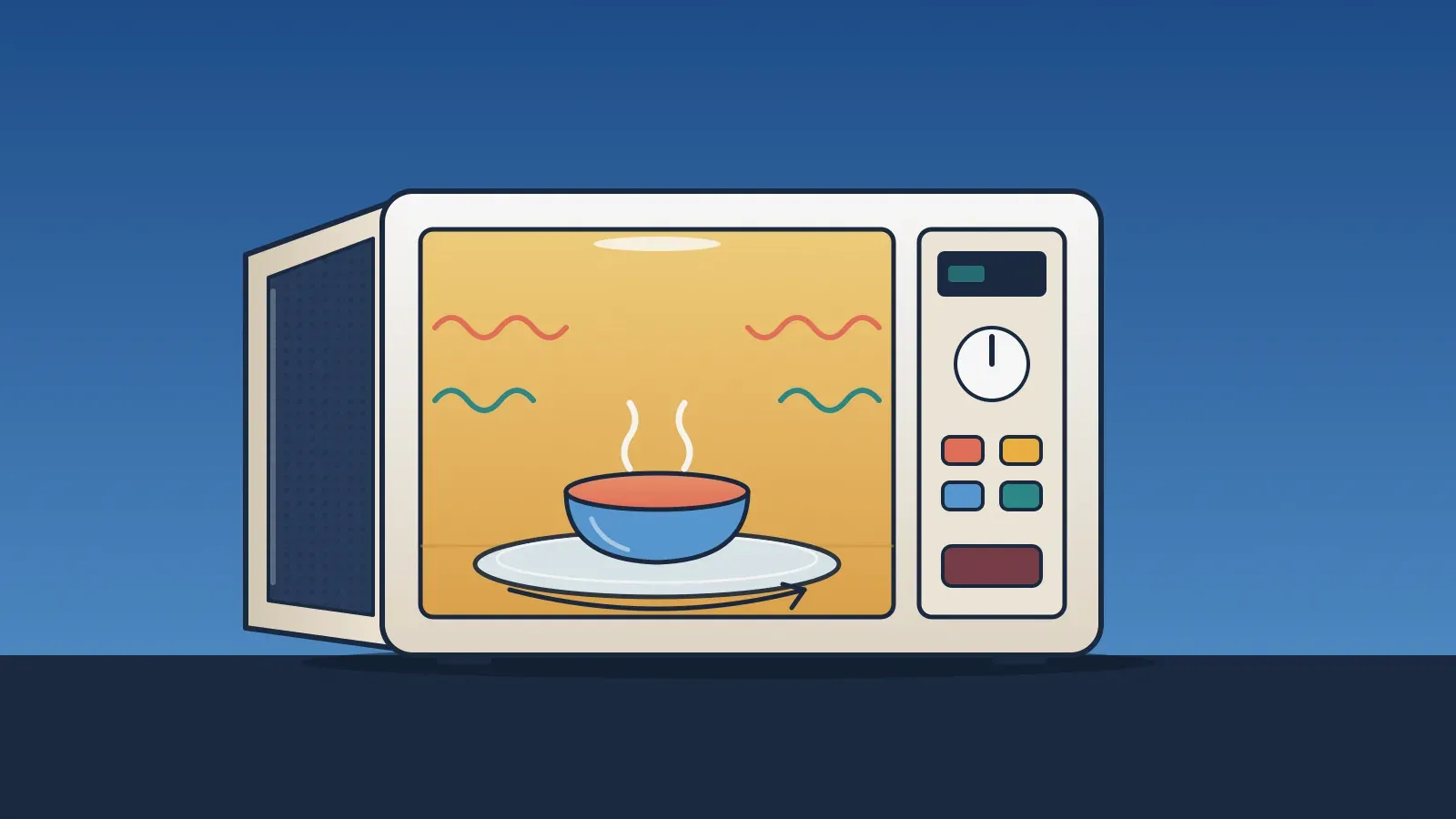
The oven produces electromagnetic waves at about 2,450 megahertz, the same family as radio waves but in a different band. The appliance's metal walls reflect these waves, which bounce around until they are absorbed by the food. Water, fats and sugars absorb this energy well: their molecules start to vibrate and rotate rapidly, and that motion turns into heat.
This kind of radiation is non-ionizing. According to the FDA and the U.S. Environmental Protection Agency (EPA), the absorbed energy turns into heat and does not make food radioactive or contaminated.
Outside in, not inside out
Microwaves do not pass through the whole piece of food. According to the U.S. Department of Agriculture (USDA), they penetrate only about 1 to 1.5 inches (2.5 to 4 cm). In thick foods, the FDA explains, the outer layers are heated mainly by the microwaves, while the center warms mostly by conduction, as heat moves from hotter parts to cooler ones.
The frequency used in home ovens helps here: it sits below the range where water absorbs energy most strongly, which lets the waves travel a little way before being absorbed instead of being used up in the very first layer. A common explanation for the myth is that, in some foods, the surface loses heat to the air and through evaporation, so a layer just beneath it can end up hotter. That does not mean the center heats first.
Why food heats unevenly
Several factors combine to create very hot spots and still-cold spots on the same plate:
- Limited depth: thick pieces rely on conduction to heat the middle, which is slow.
- Wave distribution: inside the oven, waves overlap and form zones with more and less energy. The turntable is there so the food moves through those zones.
- Ice versus water: ice absorbs microwaves far less than liquid water. When defrosting, parts that thaw first heat up faster and faster while frozen parts stay cold.
- Composition and shape: parts with more water, fat or sugar, and thinner pieces, heat up faster.
- Metal containers and aluminum foil reflect the waves and can cause uneven cooking, as well as damage the appliance.
Stir, turn and let it stand
Because heat needs time to spread, the USDA recommends stirring, turning or rotating food halfway through cooking and then letting it stand for at least 3 minutes before eating. During that standing time the food keeps cooking, as heat moves from hot areas into cold ones. Covering the dish with a microwave-safe lid also helps trap steam and spread the heat.
Cold spots are not just a matter of comfort. According to the USDA, bacteria can survive in them. For leftovers and ready-to-eat dishes, the guidance is to reheat until steaming and check with a food thermometer, in several places, that the internal temperature has reached 165 °F (74 °C). Follow the package directions as well, including any standing time they specify.
What to take back to the kitchen
A microwave heats from the outside in, just differently from a conventional oven: instead of warming only the surface, it deposits energy in the first few centimeters of the food. The rest is conduction, and that takes time. So shallower, spread-out portions, a stir halfway through and a few minutes of standing time are the way to a plate that is evenly hot and safer to eat.