How Lightning Forms and Why Thunder Always Arrives Late
Collisions between ice crystals and soft hail separate electric charge inside a storm cloud until the air gives way. The flash arrives almost instantly; the sound takes about 5 seconds per mile.
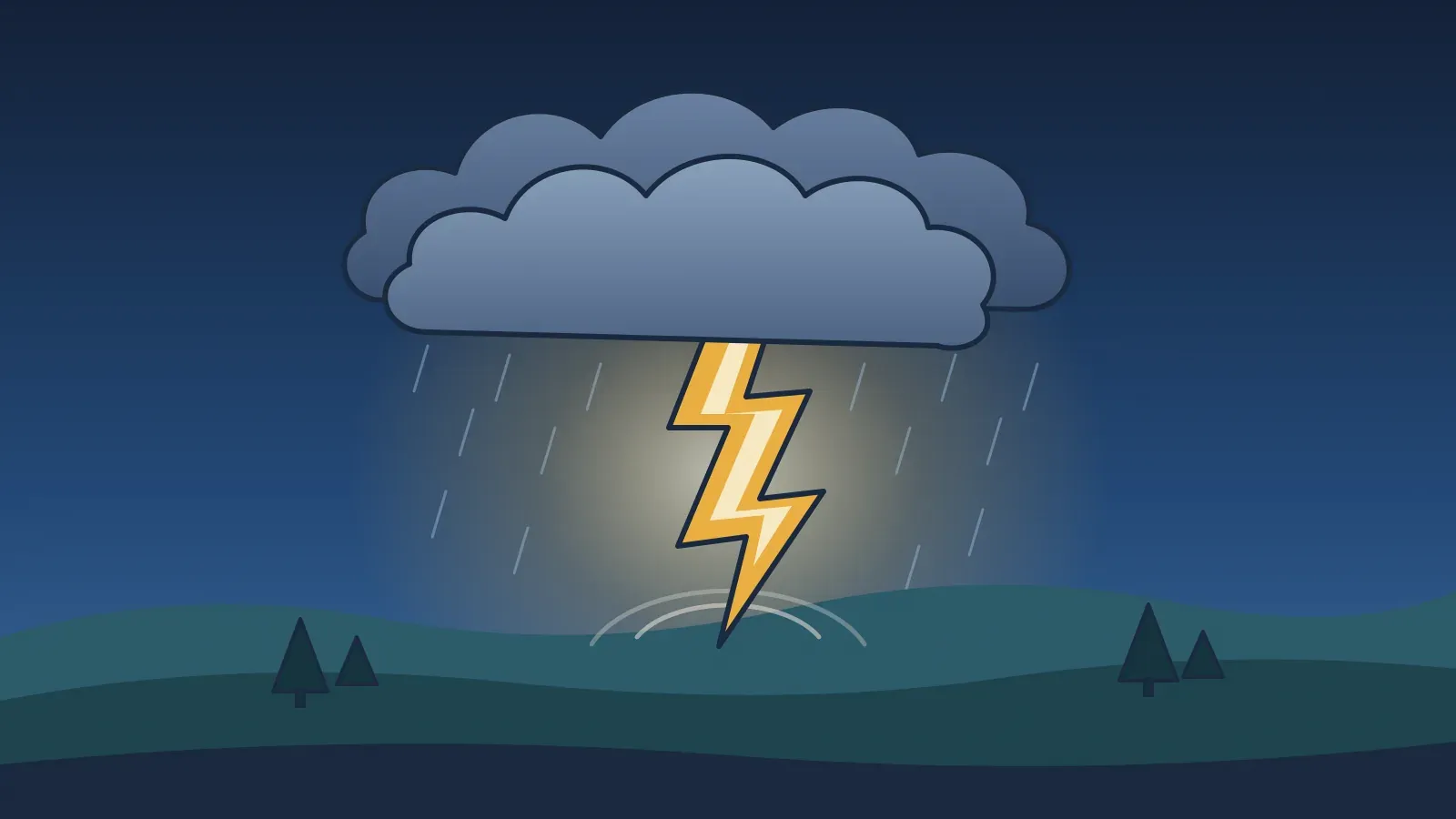
First the flash, then the boom. That order never changes, and behind it are two stories: how a cloud builds up enough electricity to tear through the air, and the huge gap between the speed of light and the speed of sound. Understanding both helps you know when it is time to take shelter.
How a storm cloud gets charged
Inside a thunderstorm there are strong rising air currents, supercooled water droplets, ice crystals and small pellets of soft hail called graupel. According to the U.S. National Severe Storms Laboratory (NSSL), when graupel collides with smaller ice crystals, one picks up a charge of one sign and the other the opposite sign. The lighter crystals are carried upward by the updrafts, while the heavier graupel stays in the middle or falls.
In most storms, the result is a positive region near the top of the cloud and a negative region in the middle, often with a small positive area lower down. This ice and graupel collision model is the most widely accepted explanation, but the exact details of how each particle gains its charge are still being studied.
From charge buildup to a lightning bolt
Air is normally a good insulator. When the charge difference grows too large, however, it breaks down and electricity forces its way through in a discharge: lightning. Most flashes begin inside the cloud. Some stay there (intra-cloud lightning), others jump between clouds, and others reach the ground, which are the most dangerous for us.
The discharge heats the air in its channel to about 50,000 °F (roughly 28,000 °C), according to the U.S. National Weather Service (NWS), around five times hotter than the surface of the Sun. That intense heating makes the air expand explosively and then contract just as fast. The pressure wave created by that back-and-forth is thunder.
Why thunder arrives later
The flash and the boom are born at practically the same moment, but they travel very differently. Light covers about 300,000 kilometers (186,000 miles) per second, so it reaches your eyes almost immediately. Sound moves through air at about 343 meters (1,125 feet) per second at 20 °C (68 °F), a little slower in the cold. That means it takes roughly 5 seconds to cover each mile, or about 3 seconds per kilometer.
- When you see the flash, start counting seconds.
- Stop counting when you hear the thunder.
- Divide the number of seconds by 5 for the approximate distance in miles (or by 3 for kilometers).
- Example: 15 seconds means a strike about 3 miles (5 km) away.
This method is an estimate, not an exact measurement. According to the NWS, thunder can usually be heard up to about 10 miles (16 km) from the strike. A sharp crack means the discharge was very close; a long rumble means it was several miles away.
Basic safety rules
The official NWS guidance is simple: if you can hear thunder, you are probably close enough to be struck. There is no safe place outdoors during a thunderstorm.
- When you hear thunder, get inside a substantial enclosed building or a hard-topped metal vehicle.
- Open shelters, gazebos, tents and open vehicles do not protect you from lightning.
- Indoors, avoid touching anything plugged into an outlet, plumbing and corded phones; cell phones and cordless phones are safe.
- Stay away from doors and windows that lead outside.
- Wait 30 minutes after the last thunder or lightning before going back out.
People struck by lightning do not carry an electrical charge and are safe to touch. Call emergency services right away; medical professionals should check the person even if they seem fine.
In short: lightning comes from charge separation between ice and graupel inside the cloud, and thunder is the sound of superheated air expanding. Because light is almost instantaneous and sound takes about 5 seconds per mile, counting the seconds gives a good sense of distance. But if you can hear thunder at all, the more important calculation is a different one: it is time to find shelter.