Why the Moon Has Phases, and Why Earth's Shadow Isn't the Reason
Half of the Moon is always lit by the Sun; what changes is how much of that half we can see as it circles Earth. Earth's shadow only shows up during eclipses.
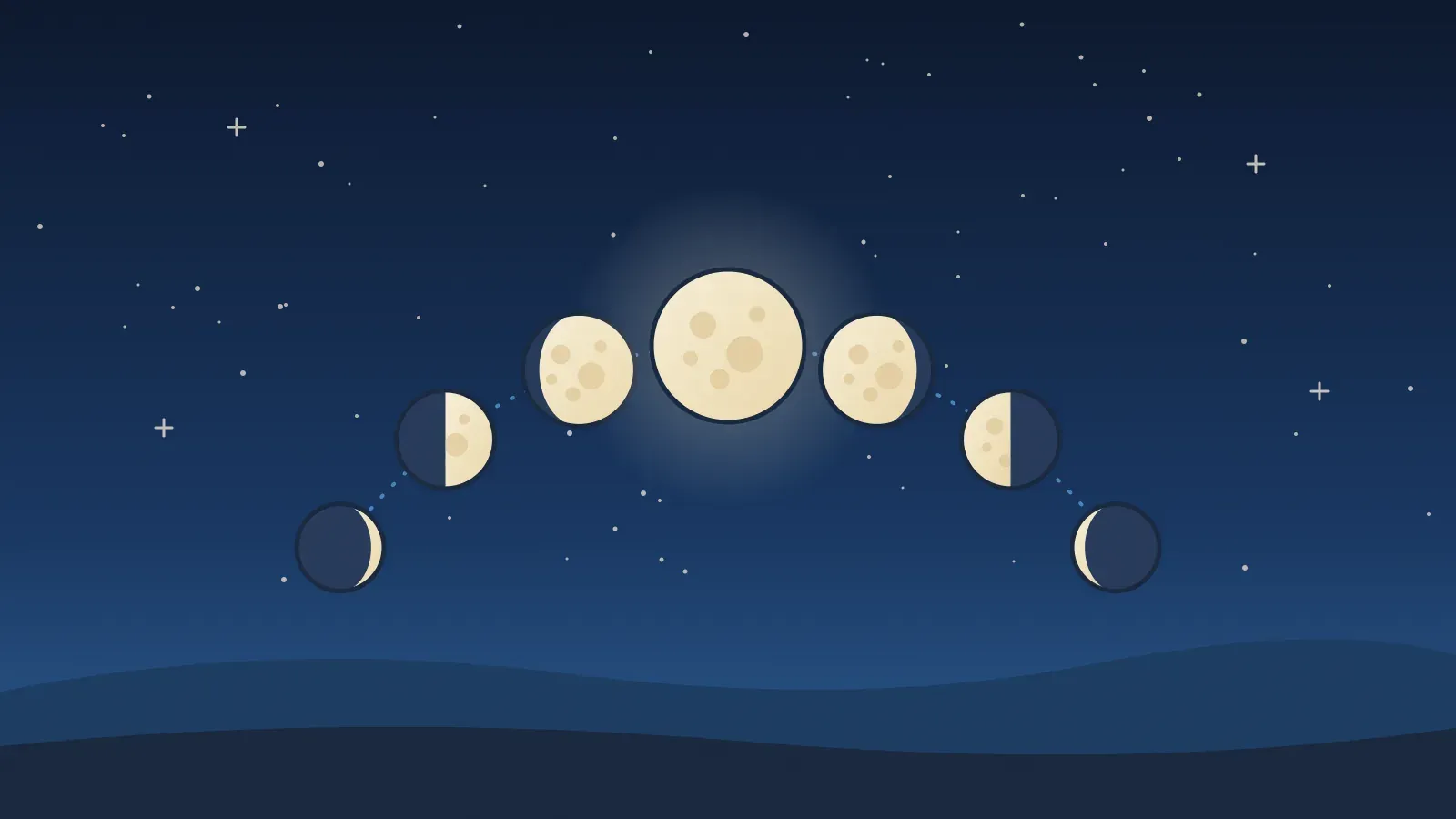
Over the course of a month, the Moon goes from a thin sliver to a full disk and back to nothing. Many people assume this happens because Earth's shadow covers part of it. It does not. Phases are a matter of angle: they depend on how much of the Moon's sunlit half is facing us.
Half of the Moon is always lit
The Moon makes no light of its own. It shines because it reflects sunlight, and like any sphere lit by a single source, it always has one bright half and one dark half. That holds true at every point in the month, including at new moon.
What changes is our position relative to that sunlit half. As the Moon travels around Earth, we sometimes see the whole bright side, sometimes only the dark side and, most of the time, a mix of the two. Picture a ball lit by a lamp in a dark room: as you walk around it, you see the same shapes as the phases.
The phases, one by one
The cycle is usually divided into eight phases, summarized in the table.
| Phase | What we see | Approximate position |
|---|---|---|
| New moon | Practically nothing | Moon between Earth and the Sun |
| Waxing crescent | A growing sliver of light | East of the Sun; seen in the evening |
| First quarter | Half the disk lit | 90° from the Sun |
| Waxing gibbous | More than half, growing | Between first quarter and full |
| Full moon | Entire disk lit | Earth between the Sun and the Moon |
| Waning gibbous | More than half, shrinking | Between full and last quarter |
| Last quarter | Half the disk lit | 90° from the Sun, on the other side |
| Waning crescent | A shrinking sliver of light | West of the Sun; seen before dawn |
An interesting detail: the lit side appears flipped between hemispheres. In the Southern Hemisphere, a waxing crescent has its bright edge on the opposite side from the one seen in the Northern Hemisphere. The phase is the same; only the point of view changes.
Why it is not Earth's shadow
If phases were caused by Earth's shadow, Earth would have to sit between the Sun and the Moon whenever we saw a dark portion. But during a crescent phase, the Moon appears in the sky fairly close to the Sun, sometimes even in daytime, and in those positions Earth's shadow points off in the opposite direction.
The shape does not match, either. During the phases, the edge of the dark part is a curve that changes throughout the month. Earth's shadow, when it does fall on the Moon, moves across it as a rounded dark patch, and that only happens during one specific event: a lunar eclipse.
A phase is not an eclipse
A lunar eclipse happens when the Sun, Earth and Moon line up almost perfectly, with Earth in the middle. That is why it can only occur at full moon. At that moment, the Moon moves into Earth's shadow and, during a total eclipse, can take on a reddish tint, because Earth's atmosphere bends orange and red light into the shadow. A solar eclipse is the reverse: the Moon passes between Earth and the Sun, which can only happen at new moon.
So why is there not an eclipse every month? Because the Moon's orbit is tilted about 5 degrees relative to the plane of Earth's orbit. At most full moons, the Moon passes slightly above or below Earth's shadow. An eclipse only happens when a full moon coincides with the Moon crossing that plane. Some years have no lunar eclipses at all, while others have two or more.
Why the cycle lasts about 29.5 days
The Moon completes one orbit of Earth, measured against the distant stars, in about 27.3 days. This is the sidereal month. During that time, however, Earth has also moved along its orbit around the Sun. To return to the same position relative to the Sun and repeat the same phase, the Moon has to travel a bit farther. That is why the interval from one new moon to the next, called the synodic month or lunation, averages about 29.5 days.
In short: the Moon always has one sunlit half, and its phases show how much of that half is turned toward Earth. Earth's shadow only comes into play during lunar eclipses, which require a full moon and a near-perfect alignment. Next time you see a crescent Moon in the early evening, notice that its bright side points toward where the Sun has just set.