Why Ice Floats, and Why Fish Are Grateful for It
When water freezes, hydrogen bonds lock its molecules into an open network that is less dense than the liquid. That small chemical quirk keeps lakes from freezing from the bottom up.
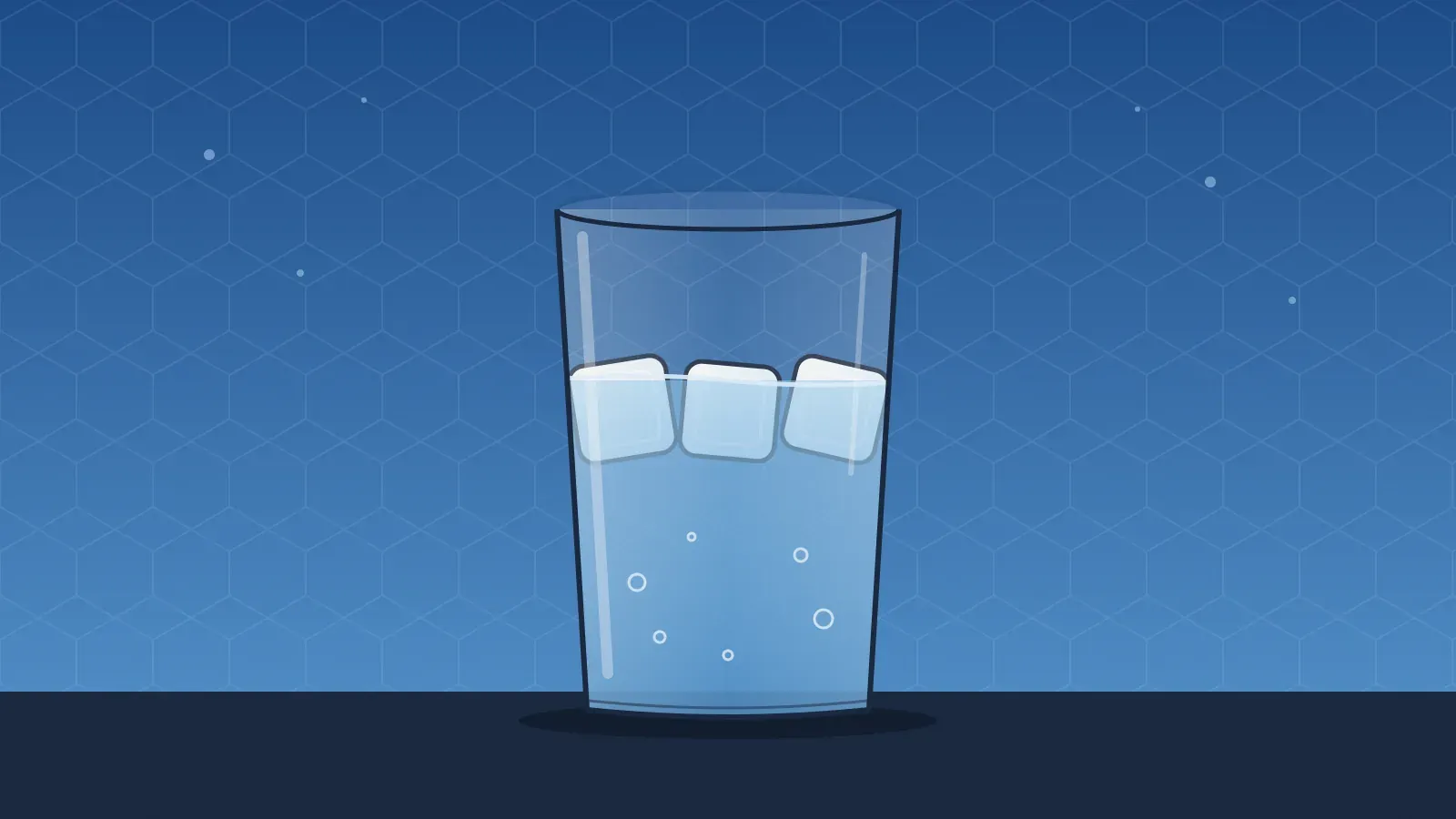
Drop an ice cube into a glass of water and it floats, mostly submerged with a small tip poking out. It seems obvious, but it is actually an exception: for most substances, the solid is denser than the liquid and sinks. Water does the opposite, and the reason lies in how its molecules fit together.
An exception to the rule
Normally, as a liquid cools, its molecules slow down and move closer together. When it solidifies, they pack tightly, so the solid takes up less space. That is why a chunk of solid paraffin wax sinks in melted wax.
Water behaves differently. At 0 °C (32 °F), liquid water has a density of about 0.9998 g/cm³, while ordinary ice is about 0.917 g/cm³. Sources round this gap slightly differently: the U.S. Geological Survey (USGS) says ice is about 9% less dense; using the exact values, the density difference is closer to 8%, which corresponds to roughly a 9% increase in volume on freezing. In practice, about 90% of an ice cube or an iceberg sits below the waterline.
The role of hydrogen bonds
A water molecule has one oxygen atom and two hydrogen atoms. Oxygen pulls electrons toward itself, leaving the hydrogens slightly positive and the oxygen slightly negative. So the hydrogen of one molecule is attracted to the oxygen of its neighbor. That attraction is a hydrogen bond.
In the liquid, these bonds constantly form and break, and molecules can crowd quite close together. In ordinary ice, known as ice Ih, they become fixed: each oxygen is surrounded by four hydrogens, two from its own molecule and two from neighboring molecules. The result is a hexagonal crystal lattice with open space in the middle of each hexagon. More empty space for the same mass means lower density.
| Condition | Approximate density (g/cm³) |
|---|---|
| Liquid water near 4 °C (39 °F) | 1.000 |
| Liquid water at 25 °C (77 °F) | 0.997 |
| Liquid water at 0 °C (32 °F) | 0.9998 |
| Ordinary ice at 0 °C (32 °F) | 0.917 |
Why water is densest near 4 °C
Liquid water has another quirk: it is not densest at its freezing point but at around 4 °C, or 39 °F (more precisely, about 3.98 °C). Above that temperature, it acts like most liquids, expanding as it warms. Below it, however, water starts expanding again as it gets colder.
The most widely accepted explanation is a tug-of-war between two effects. Cooling reduces molecular motion and brings molecules closer, but it also favors more open, ice-like arrangements. Below about 4 °C, the second effect wins. The finer details of liquid water's structure are still being researched, but the measured fact, maximum density near 4 °C, is settled.
What this means for life in a frozen lake
In cold climates, this combination shapes what happens to lakes in winter. In autumn, surface water cools, becomes denser and sinks, mixing the lake until the whole thing is close to 4 °C. From then on, surface water that keeps cooling becomes lighter, stays on top and can freeze.
- Ice forms at the surface and floats instead of sinking and piling up on the bottom.
- The ice layer insulates the water below from the frigid air, slowing further freezing.
- The lake bottom tends to stay near 4 °C (39 °F), the warmest water in the lake at that time.
- Fish and other organisms spend the winter in that liquid water beneath the ice.
If ice sank, lakes could freeze from the bottom up and turn solid, with little if any life inside. In spring, when the ice melts and the water again becomes uniform near 4 °C, wind and currents mix the lake once more, carrying oxygen to the bottom and nutrients to the surface.
Everyday consequences
Water's expansion on freezing also has a downside. It can burst pipes, crack bottles left in the freezer and damage roads when water seeps into cracks and freezes. That is why it is a bad idea to freeze drinks in completely full, sealed glass containers.
In short: ice floats because hydrogen bonds hold its molecules in an open network that takes up more room than liquid water. The same behavior makes water densest near 4 °C and ensures that lakes freeze from the top, keeping liquid water and life underneath all winter.