The Eiffel Tower Grows Taller in Summer
The Eiffel Tower's iron expands in the heat and contracts in the cold, so the monument's height changes over the year. Here is how thermal expansion works and how much it really adds up to.
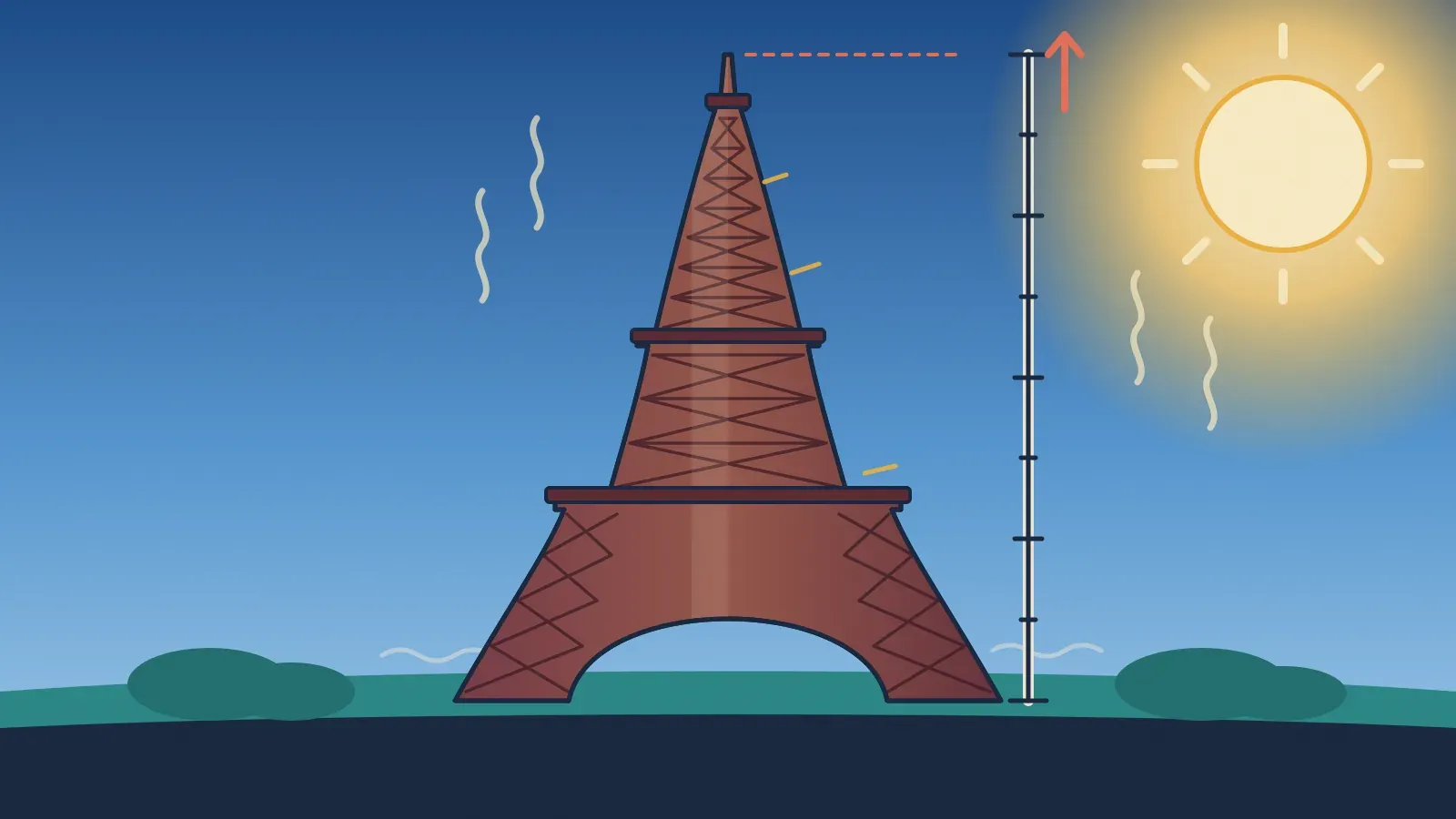
The Eiffel Tower does not have a fixed height. Built from iron, it expands slightly on hot days and contracts on cold ones, so the top of the monument rises and falls over the year. The phenomenon is called thermal expansion, and it is behind engineering details we see every day, from expansion joints on bridges to gaps between railway tracks. The interesting part is that the exact amount of growth varies a lot depending on the source, and understanding why helps separate the real figure from the hype.
What thermal expansion is
When a material heats up, its atoms vibrate more strongly and, on average, take up a bit more space. The result is that the object grows. When it cools down, the motion decreases and it shrinks. In metals this effect is small but measurable, and it scales with both the size of the piece and the change in temperature.
The measure of this tendency is the coefficient of linear expansion. For the puddled iron used in the tower, a type of 19th-century wrought iron, the value is about 12 millionths per degree Celsius. That sounds tiny, but the tower has about 300 meters (roughly 985 feet) of metal structure, and that is where the math gets interesting.
How much the tower grows, in theory
Applying the simple linear expansion formula to a 300-meter iron bar gives the approximate values in the table below. They are meant to show the scale involved, not to serve as official measurements.
| Change in metal temperature | Theoretical increase in height |
|---|---|
| 10 °C (18 °F) | about 3.6 cm (1.4 in) |
| 20 °C (36 °F) | about 7.2 cm (2.8 in) |
| 40 °C (72 °F) | about 14.4 cm (5.7 in) |
| 60 °C (108 °F) | about 21.6 cm (8.5 in) |
In Paris, the gap between the coldest winter days and the hottest summer days can exceed 40 °C (72 °F) in air temperature, and metal in direct sunlight can get much hotter than the surrounding air. That is why estimates cited by engineers put the difference between extremes at around 12 to 15 centimeters (about 5 to 6 inches), and some articles go as high as 20 centimeters.
Why the numbers vary so much
The Eiffel Tower's official website takes a much more modest tone, saying the tower gains or loses "a few millimeters" with the seasons. There are reasonable explanations for the gap between these sources:
- The tower is not a solid bar: it is a lattice of more than 18,000 pieces, and each part heats up differently.
- One side sits in the sun while the other is in shade, so the structure is never all at the same temperature.
- The larger estimates assume absolute temperature extremes, which rarely occur back to back in the same year.
- Comparing a single cold day with a single hot day is different from comparing winter and summer averages.
In practice, the safest statement is that the tower's height varies by a few centimeters between bitter cold and strong heat, with estimates ranging from a few millimeters to about 15 centimeters depending on the method and conditions considered.
The tower also leans away from the Sun
There is a lesser-known effect, confirmed by the monument's official website. On a sunny day, the side facing the Sun heats up and expands more than the shaded side. This makes the tower bend slightly away from the Sun. As the Sun moves across the sky during the day, the top traces a curve about 15 centimeters (6 inches) across, a movement invisible to the naked eye that poses no threat to the structure.
It is worth remembering that the official height has also changed for another reason: at its opening in 1889 the tower stood 312 meters (1,024 feet) tall; with antennas added over the decades, most recently in 2022, it now reaches 330 meters (1,083 feet). That change is permanent, unlike the seasonal variation, which comes and goes every year.
The Eiffel Tower is a large-scale example of something that happens to any metal. It does not grow by meters or become unsafe, but it breathes with the seasons, gaining and losing a few centimeters at most. And it is precisely because they anticipate this behavior that engineers leave room for movement in bridges, rails and metal structures of every kind.