On Venus, a Day Lasts Longer Than a Year
Venus takes about 243 Earth days to spin once on its axis but only about 225 to orbit the Sun. And it spins backward compared with Earth.
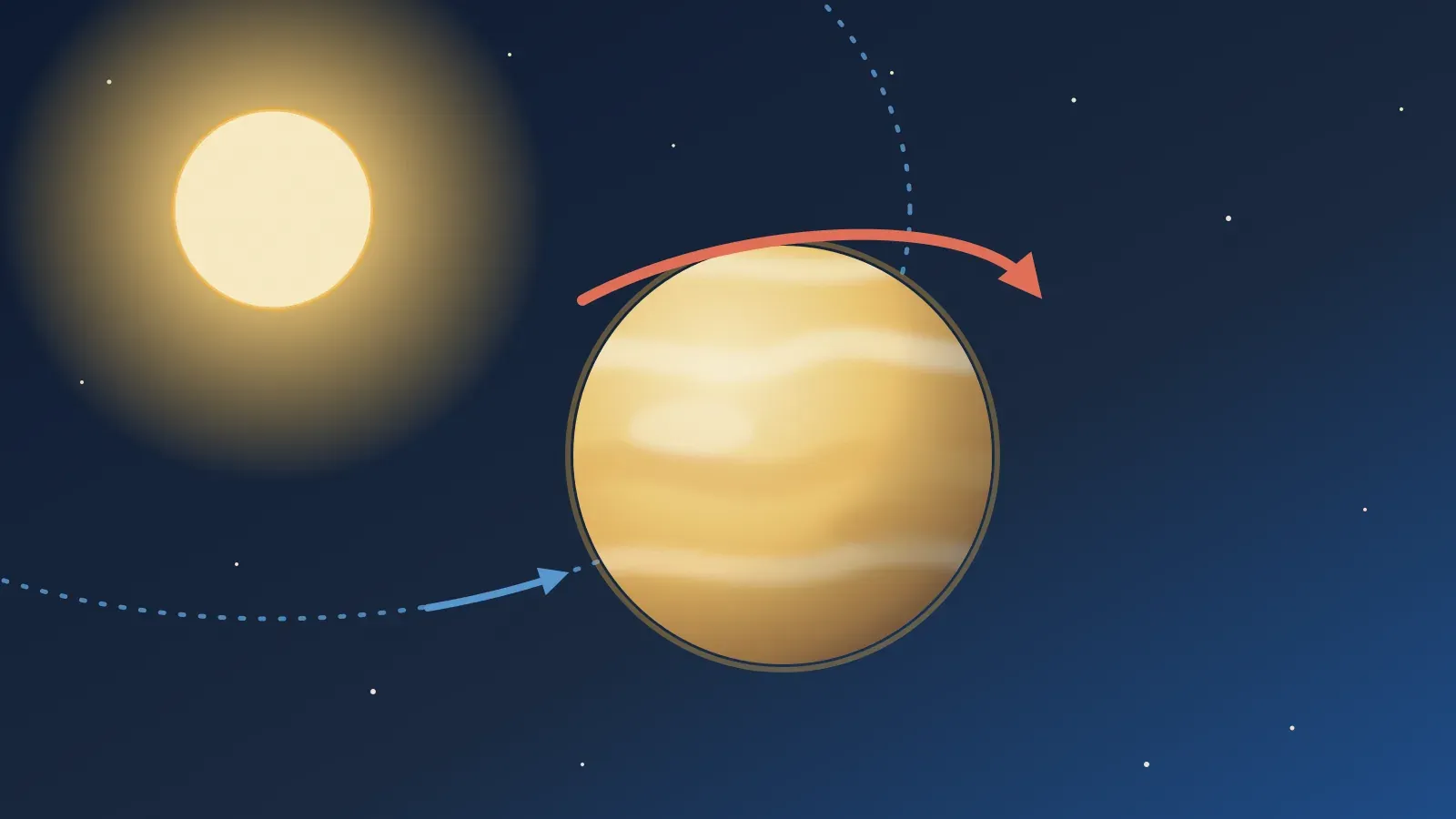
Venus takes longer to spin once on its own axis than to complete a full trip around the Sun. One rotation takes about 243 Earth days, while a Venusian year lasts about 225. On top of that, the planet spins in the opposite direction to Earth, so anyone standing on its surface would see the Sun rise in the west. To make sense of this oddity, it helps to separate two motions we usually blur together in everyday life.
Rotation and orbit: two different clocks
Every planet has two main motions. Rotation is the spin around its own axis, and it sets the length of a day. Revolution, or orbit, is the full trip around the Sun, and it sets the length of a year. On Earth the two clocks are very different: we spin once in just under 24 hours and take about 365 days to complete our orbit. On Venus the two values ended up surprisingly close, and rotation is actually the slower one.
| Measure | Earth | Venus |
|---|---|---|
| Rotation relative to the stars (sidereal day) | 23 h 56 min | about 243 Earth days |
| Trip around the Sun (year) | about 365 days | about 224.7 Earth days |
| From one sunrise to the next (solar day) | 24 hours | about 117 Earth days |
| Direction of spin | west to east | east to west (retrograde) |
So which day is longer than the year?
There is a subtlety here that many articles skip. Astronomers use two definitions of a day. A sidereal day is the time a planet takes to rotate 360 degrees relative to distant stars. A solar day is the time between two consecutive sunrises, which is what we actually experience.
The statement "a day on Venus is longer than a year" holds for the sidereal day: about 243 Earth days versus a 225-day year. The Venusian solar day, however, lasts about 117 Earth days, because the backward spin combines with the planet's movement along its orbit and brings the Sun back to the same spot in the sky sooner. The result: during one Venus year, the Sun rises roughly twice.
A planet that spins backward
Nearly every planet in the Solar System spins in the same direction it orbits the Sun. Venus is an exception: its rotation is retrograde, meaning it turns the opposite way. For an observer on the surface, the Sun would rise in the west and set in the east. In practice nobody would see it, since the surface is hidden under a permanent layer of thick clouds.
No one knows for sure why Venus spins this way. The most commonly cited hypothesis is that, while it was forming, the planet was struck by a large body that tipped its axis and slowed its spin. No explanation is yet considered fully satisfactory.
More quirks of the Venusian clock
- Venus has the slowest rotation of any planet in the Solar System.
- While the planet turns slowly, its clouds circle it completely in about four days, pushed by winds of roughly 100 meters per second (about 220 mph) at the cloud tops. This is called super-rotation, and its cause is still debated.
- Different measurements have produced slightly different rotation values: in 2012, the European Venus Express probe suggested a sidereal day about 6.5 minutes longer than the one calculated by NASA's Magellan probe in the 1990s.
- The average surface temperature is about 464 °C (867 °F), hot enough to melt lead, because of the intense greenhouse effect of its carbon dioxide-rich atmosphere.
The lesson from Venus is that "day" and "year" are not universal measures but consequences of how each planet spins and orbits. When you read that a Venusian day is longer than its year, remember that it refers to a full rotation relative to the stars; from the point of view of someone waiting for sunrise, the day would last about 117 Earth days, still one of the longest in the Solar System.