Why Babies Are Born With More Bones Than Adults
A newborn has around 300 separate bony pieces, yet an adult ends up with 206. The difference comes from bones fusing together through childhood and early adulthood.
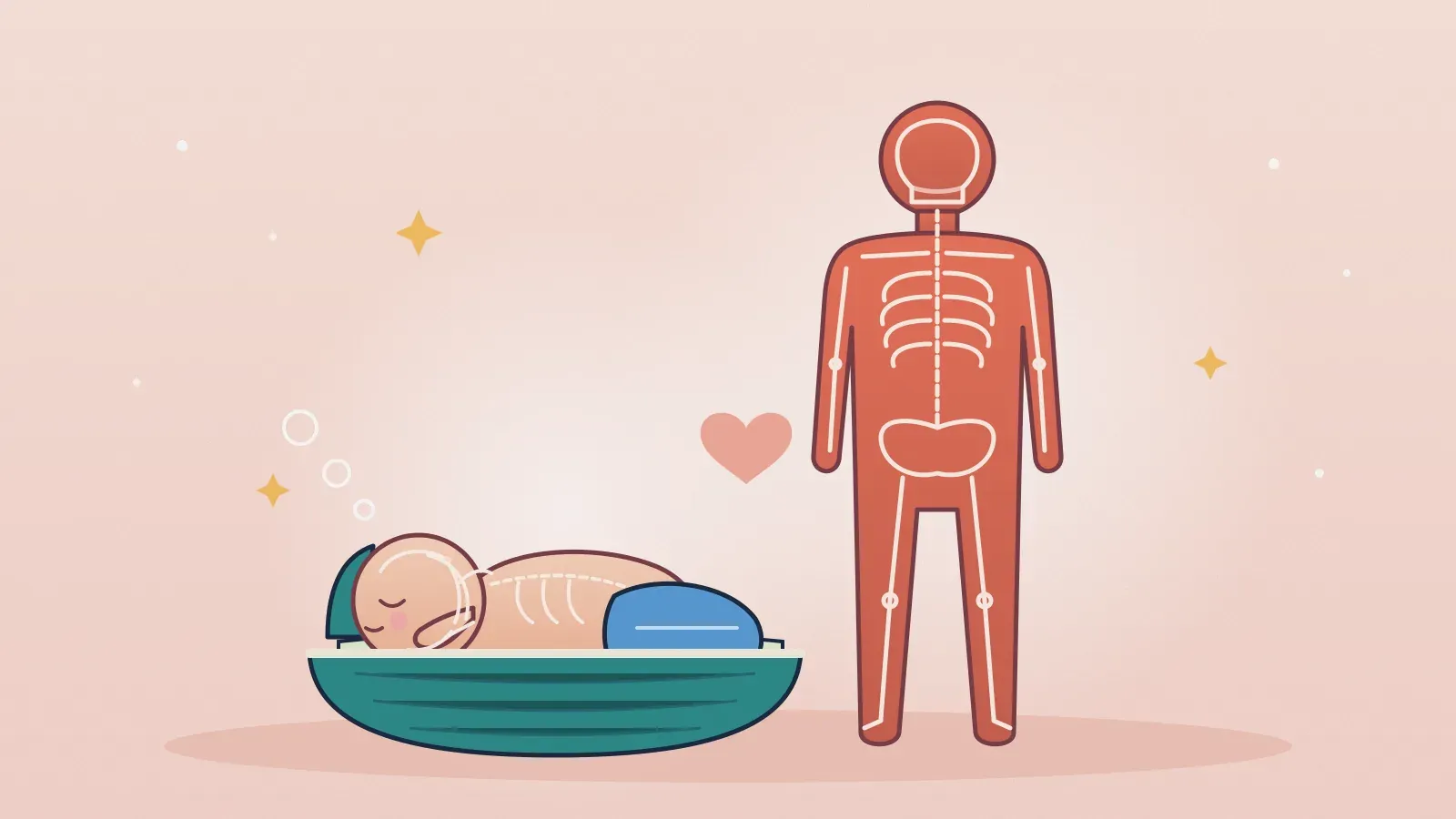
A newborn baby has nearly a hundred more bones than its parents. The adult skeleton is usually described as having 206 bones, while a newborn's has around 300 separate bony and cartilaginous pieces. None of them disappear along the way. Instead, many of them gradually fuse into the larger, sturdier structures of the adult body.
Where the extra bones come from
The exact number for babies depends on how you count. Commonly cited estimates range from about 270 to just over 300, because there is no single agreed rule on whether every ossification center and cartilage piece counts as its own bone. What all sources agree on is that a baby starts out with far more separate elements than an adult.
Much of a newborn's skeleton is still cartilage, a tissue that is more flexible than bone. Bone formation, called ossification, begins around the eighth week of embryonic development and continues for years after birth. Cells called osteoblasts lay down bone tissue over the cartilage and gradually replace it. When two neighboring pieces complete this process, the cartilage between them also turns into bone and they start working as one.
Which bones fuse, and when
Fusion does not happen all at once. Some of it is finished in the first months of life, while some is only complete in adulthood. The timings below are typical averages and vary from person to person.
| Area | What joins together | Typical timing |
|---|---|---|
| Skull (posterior fontanelle) | Bones at the back of the head | Around 2 months |
| Skull (anterior fontanelle) | Bones at the top and front of the head | Between about 7 and 18 months |
| Skull (metopic suture) | The two halves of the frontal bone | Between 3 and 9 months |
| Hip | Ilium, ischium and pubis form the hip bone | Fusion begins around ages 15 to 17 |
| Sacrum | Five vertebrae become a single bone | Starts around puberty, finishes around ages 25 to 30 |
| Coccyx (tailbone) | 3 to 5 fused segments | Varies widely between people |
The skull and its soft spots
The best-known example is the head. A baby's skull is made of separate bony plates joined by bands of fibrous tissue called sutures. Where several sutures meet there are gaps known as fontanelles, or soft spots. The posterior fontanelle, at the back of the head, usually closes by around 2 months. The anterior fontanelle, the largest one, on top of the head, closes between about 7 and 18 months.
Even after the soft spots close, some sutures stay open for a long time. According to averages cited by Cleveland Clinic, the sagittal suture closes around age 22, the coronal around 24 and the lambdoid around 26. The squamous suture may not fully close until around age 60.
Why starting with more bones is an advantage
A skeleton made of many pieces, with plenty of cartilage, brings real benefits early in life:
- Getting through the birth canal: the skull plates can shift slightly, which helps the head pass through.
- Room for the brain to grow: open sutures and fontanelles let the skull keep up with the rapid brain growth of the first years.
- Flexibility: cartilage makes a baby's body more pliable, both in the womb and after birth.
- Growing taller: growth plates at the ends of long bones let arms and legs lengthen until the end of adolescence.
Not every adult has exactly 206 bones
The number 206 is a reference, not a fixed rule. Some people have an extra vertebra in the lower spine, an extra rib near the neck, or additional sesamoid bones, small bones that form inside tendons. The kneecap is a sesamoid that almost everyone has. In most cases these variations cause no symptoms and are only discovered by chance on an X-ray or scan.
In short, babies do not lose bones as they grow: they join them together. The skeleton starts as a set of flexible pieces, ideal for birth and rapid growth, and ends up as a stiffer, stronger structure in early adulthood. If you have questions about a child's soft spot closing or bone development, a pediatrician is the right person to assess it, since premature babies or those with certain health conditions can follow a different schedule.