Why Do You Have to Use Airplane Mode on a Plane? What the Rules Say
Airplane mode switches off a phone's radio transmitters to avoid interference with aircraft systems and with cell towers on the ground. The rules have relaxed, and each airline now decides what to allow.
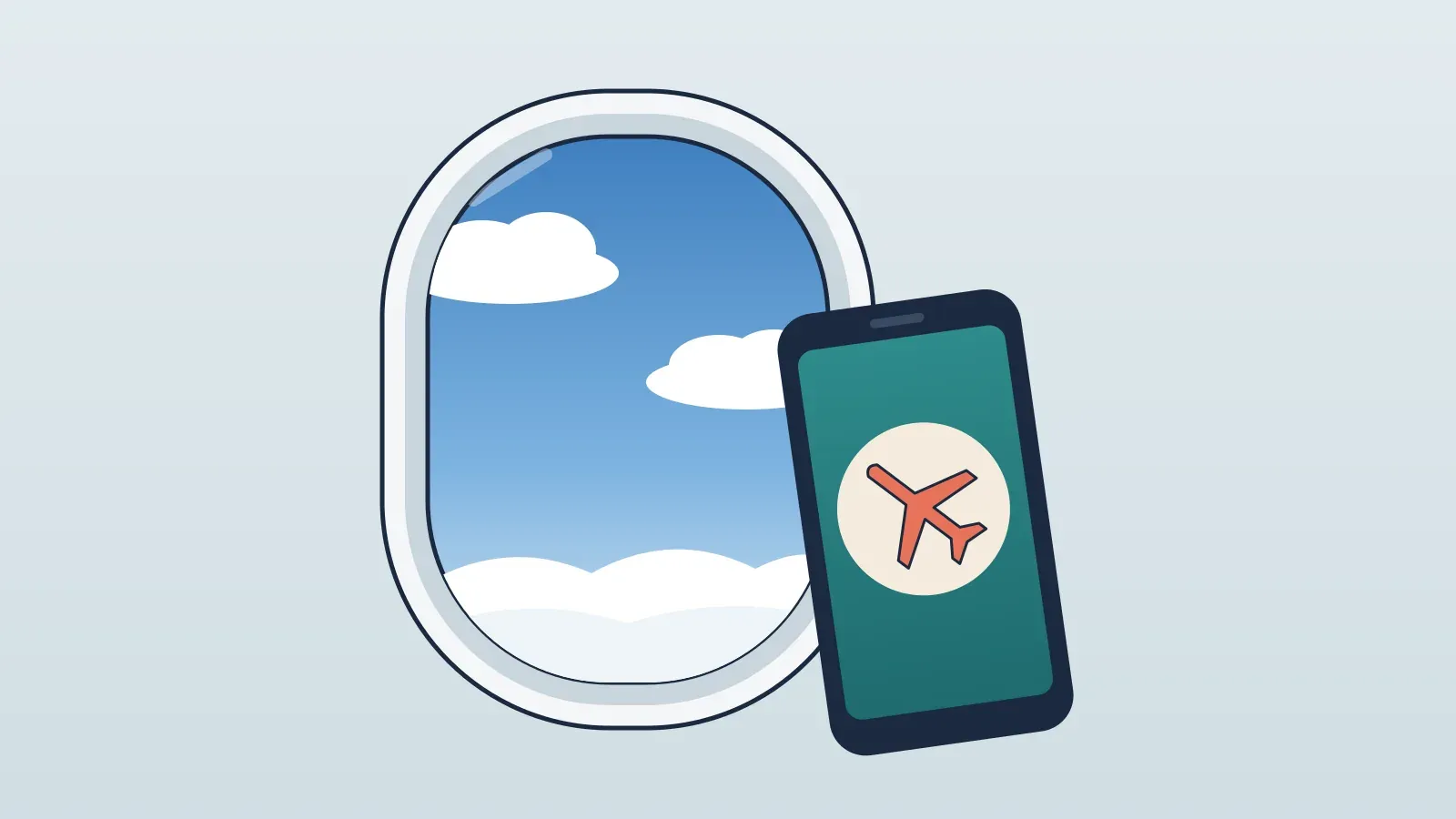
You are asked to use airplane mode for two reasons: to cut a small but hard-to-rule-out risk of interference with the aircraft's navigation and communication systems, and to stop phones in the air from disrupting cell towers on the ground. In the United States, the second reason is backed by an FCC rule. Details vary by country and airline.
What does airplane mode actually turn off?
Airplane mode silences a device's transmitters: cellular calls and data, and usually Wi-Fi and Bluetooth too. The phone itself stays on, so you can still read, play downloaded music or games, and look through photos. The FAA's guidance tells airlines to have passengers turn off phones, disable their cellular transmitting functions, or place them in airplane mode while airborne.
On most phones you can switch Wi-Fi or Bluetooth back on while airplane mode stays active. That is why airlines with onboard internet tell you when it is OK to connect. The airline sets that moment, not the passenger, and it can differ from one flight to the next.
Can a phone really interfere with a plane's instruments?
The concern is electromagnetic interference. According to the FAA, its rule on portable electronic devices exists because of their potential to interfere with aircraft navigation or communication systems. The agency also admits that the sheer number and variety of devices make testing them one by one impractical, so accepted methods check whether the aircraft as a whole tolerates their emissions. Until an airline has shown that, the simplest safeguard is to keep transmitters off.
The FAA also asks airlines to have a way to report suspected interference: if a device seems to be causing trouble in cruise, crews should isolate it, note the conditions and have it switched off. Radio devices fighting over the airwaves is not unique to aviation; the same kind of clash explains why a microwave can slow down your Wi-Fi.
Why do cell towers on the ground care?
This is the lesser-known reason. The Federal Communications Commission bars using cell phones on the cellular network while an aircraft is airborne. In a 1991 order on the rule, the FCC explained that an airborne phone has a much greater range than one on the ground, so its signal is picked up by many cell sites at once, causing harmful interference; because the phone can use any of its assigned channels, the trouble can even spill into other markets.
The FAA says the ban, which applies unless the aircraft has equipment to control phones on board, exists to eliminate interference between ground-based cell stations and airborne devices, and it supports the rule in U.S. airspace. On the ground, at the gate or while taxiing, the FAA allows cell phone use.
What has changed in recent years?
In Europe, the European Union Aviation Safety Agency (EASA) moved in December 2013 to allow smartphones and tablets in almost every phase of flight, provided they were in airplane mode. It later went further: European airlines may let devices stay on and connected, without airplane mode, for the whole flight, but only after an assessment confirms that the aircraft's systems are not affected. EASA also lets airlines allow phone use right after landing.
Real cell service in the air exists too. Since 2008 the European Union has reserved frequencies for mobile communications on aircraft, and in November 2022 the European Commission added 5G. A small base station in the cabin, called a picocell, links passengers' phones and usually routes the traffic by satellite to a ground network, so phones never need to reach towers far below. For what the new generation adds, see what 5G is and how it differs from 4G.
So what still applies today?
- The crew has the final word: each airline decides which devices may be used and when.
- On flights in U.S. airspace, phones may not connect to the cellular network in the air; on the ground, they can.
- Onboard Wi-Fi and Bluetooth depend on the airline, which must have assessed how its aircraft tolerate them.
- In the European Union, aircraft with a picocell can offer calls, texts and data through the onboard network.
Airplane mode has gone from a blanket ban to a default setting: it holds until an airline proves, aircraft by aircraft, that it can offer more. When the flight attendant asks, the answer is still easy. Switch on airplane mode, then turn Wi-Fi back on only if the airline says you can.
Sources
- FAA: AC 91.21-1D, Use of Portable Electronic Devices Aboard Aircraft
- FCC: Report and Order FCC 91-399, Airborne Use of Cellular Telephones
- EASA: EASA allows electronic devices to remain On and Connected throughout the flight
- European Commission: 5G on planes, Wi-Fi on the road – Commission decision opens up new opportunities for innovation