Where Does the @ Symbol Come From, and Why Is It Called "At"?
The @ was a merchants' shorthand long before email. In English it meant "at the rate of"; in Spanish and Portuguese it marked the arroba, an old Arabic-derived unit of weight. Ray Tomlinson put it in email in 1971.
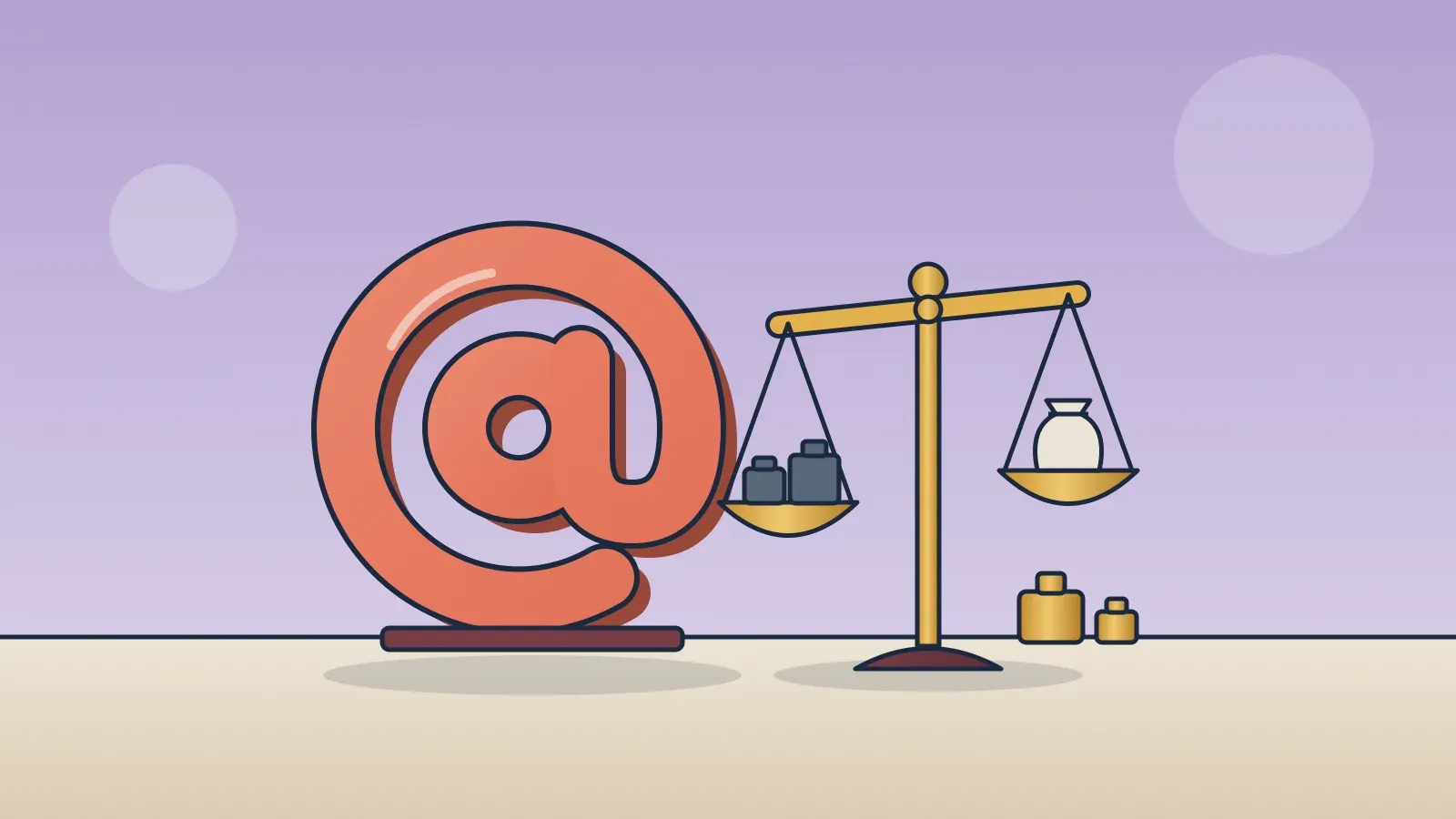
The @ is called the "at sign" because English-speaking merchants used it to mean "at the rate of," as in "12 widgets @ $1." In Spanish and Portuguese, the same mark is called arroba, after an old unit of weight of Arabic origin that it once abbreviated. Engineer Ray Tomlinson put it into email addresses in 1971.
So the symbol on every email address is really a piece of bookkeeping. It spent centuries in merchants' ledgers, nearly disappeared from machines, and then found a second career in computing.
Why is @ called arroba in Spanish and Portuguese?
The arroba was a measure of weight brought to the Iberian Peninsula by the Arabs. Its name comes from the Arabic ar-rub', meaning "the fourth part": an arroba was a quarter of a quintal, another old unit of mass. The exact value changed from place to place and century to century. In Brazil, an arroba is still 15 kilograms, roughly 33 pounds, and is used to weigh cattle sold for slaughter.
Spanish and Portuguese merchants wrote weights and prices by hand, and a quick sign for "arroba" saved ink and time. The Cambridge Dictionary blog sums it up: the symbol, under that name, comes from Spain, where arroba is an Arabic-derived word for a standard weight. The sign simply took the name of the measure it stood for.
What is the oldest known commercial use of @?
In 2000, Giorgio Stabile, a historian of science at La Sapienza University in Rome, came across a merchant's letter dated May 4, 1536. It was written by Francesco Lapi, a Florentine trader, and in it the @ marks amphorae of wine, a unit of volume shipped in large clay jars. According to Smithsonian Magazine, it is the first documented use of the sign.
Where the shape itself came from is less clear. The three most cited theories are a shorthand for the Latin preposition "ad" ("toward") used by monks, a quick form of the French "à" ("at"), and an abbreviation of "each at." There is also an isolated case in a Bulgarian manuscript from 1345 in which @ replaces the A in "amen." What is clear is that in trade the sign came to mark quantities and prices.
How did @ end up in email?
In English, the sign kept its commercial meaning. On invoices and price lists, "12 widgets @ $1" meant twelve at a dollar apiece, which is why English speakers came to read the symbol simply as "at." That bookkeeping habit is the whole reason behind the name.
The sign survived in ledgers and price lists, but for a long time it had no secure place on machines: the first typewriters, built in the mid-1800s, didn't include it, and neither did the punch-card systems used for the 1890 US census.
In 1971, Ray Tomlinson, an engineer at BBN, was working on Arpanet, the network that grew into the internet. He needed a character to separate a user's name from the name of their computer. He picked the @ on his Model 33 teletype precisely because it was rarely used in programs, so it wouldn't cause confusion. His first network message went to himself, and he later said he couldn't remember what it said. Computer keyboards inherited the QWERTY layout from typewriters, but not their lack of room for @.
What do other languages call the @?
With no international name, each language named the symbol after whatever it looked like. The Cambridge Dictionary blog and Smithsonian Magazine record several of these nicknames:
| Language | Name means | Why |
|---|---|---|
| Italian and Welsh | snail | the spiral shape |
| Polish and Bulgarian | monkey | the curled tail |
| Dutch | monkey tail | the curled tail |
| Russian | dog | a curled-up dog |
| Greek | duck | a duck's outline |
| Chinese | mouse | a mouse with its tail wrapped around |
| Czech and Slovak | rollmop (rolled herring) | a spiral snack |
| Hebrew | strudel | a rolled pastry |
| Kazakh | moon's ear | the curve of the sign |
English, oddly, never settled on a nickname. Proposals such as "asperand" and "ampersat" never caught on, so it remains the "at sign" or "at symbol." French uses "arobase," a close cousin of arroba.
Why did @ end up in a museum?
The Museum of Modern Art in New York added @ to its permanent collection, citing its modern use as an example of elegance and economy. Another everyday symbol with a long backstory is the dollar sign and where it comes from.
The next time you tag someone in a post, it's worth remembering that this typographic snail weighed sacks, wine jars and cattle long before it carried usernames.