Why Cutting Onions Makes You Cry (and How to Stop It)
When you cut an onion, it releases an irritating gas produced by a chemical chain reaction. Here is what happens inside it and which tricks actually help you cry less.
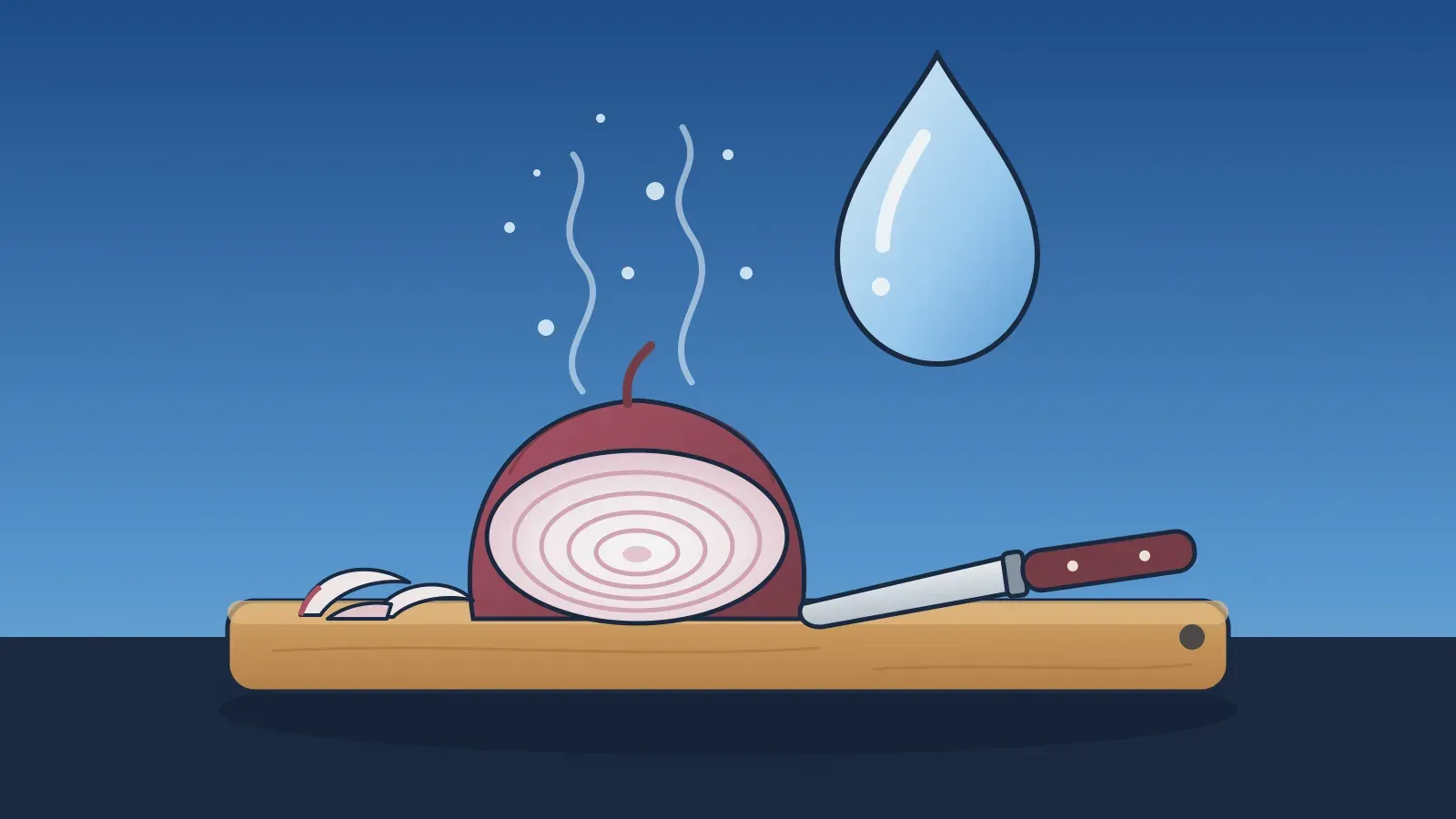
Onions make you cry because the moment a knife breaks their cells, they manufacture an irritating gas on the spot and release it into the air. That compound, called syn-propanethial-S-oxide, reaches your eyes and triggers tears. It is not a flaw in the onion: it is a chemical defense system the plant evolved against anything that tries to bite it. The good news is that understanding this chemistry helps you pick the tricks that really work.
A chemical reaction primed to fire when you cut
Onions take sulfur from the soil and store it as compounds called amino acid sulfoxides. Inside the cells, these compounds are kept apart from the enzymes that can transform them. As long as the onion is whole, nothing happens. When it is cut, crushed or bitten by an insect, the cell walls rupture, the ingredients mix, and the reaction starts within seconds.
- Cutting ruptures the cells and mixes the amino acid sulfoxides with the enzyme alliinase.
- Alliinase converts these compounds into sulfenic acids, which are unstable molecules.
- A second enzyme, lachrymatory factor synthase, turns the sulfenic acid into syn-propanethial-S-oxide.
- This compound is volatile: it evaporates, drifts up with the air and reaches your eyes.
- Once there, it irritates nerve endings, and your body responds by producing tears to wash the irritant away.
The discovery that won an Ig Nobel
For a long time, scientists blamed the tears on alliinase alone. In 2002, a team of Japanese researchers led by Shinsuke Imai of the food company House Foods reported in the journal Nature the identification of the second enzyme, lachrymatory factor synthase, which is the piece that actually makes the irritating gas. The work won the 2013 Ig Nobel Prize in Chemistry, a tongue-in-cheek award for research that first makes people laugh and then makes them think.
The discovery paved the way for onions that cause fewer tears. When this enzyme is reduced, the reaction takes another route and produces more thiosulfinates, compounds linked to the onion's typical flavor and aroma. Some sweet varieties also tend to sting less, partly because they are grown in low-sulfur soils.
What science says about no-tears tricks
There are dozens of popular tips, but they do not all rest on the same footing. These are the ones with the most solid scientific explanation:
| Trick | Why it may work | Strength of evidence |
|---|---|---|
| Use a very sharp knife and cut slowly | A Cornell University study showed that dull blades and fast cuts launch far more juice droplets into the air | Good: measured in the lab |
| Chill the onion before cutting | Low temperatures slow down the enzymes and reduce evaporation of the gas | Reasonable: based on enzyme chemistry |
| Wear well-sealed goggles | They create a physical barrier between the gas and your eyes | Logical, but little formal study |
| Cut near a vent or range hood | It carries the gas away before it reaches your face | Logical, but little formal study |
The Cornell study, published in 2025 in the journal PNAS, used high-speed cameras to film the cutting. The researchers saw that, under the pressure of the blade, juice builds up beneath the skin and is ejected in jets of droplets, some at speeds approaching 40 meters per second (about 90 mph). Duller blades produced up to 40 times more droplets, and fast cuts generated roughly four times as many as slow ones. In other words, besides the gas, fine droplets help carry the irritant up toward your eyes.
Popular tricks that come with caveats
Chewing gum, holding a piece of bread in your mouth or lighting a candle next to the cutting board are widely shared tips, but there is no good scientific evidence that they work. Cutting the onion under running water may reduce the gas that reaches your eyes, but it makes the knife slippery and raises the risk of accidents, so it is not worth it.
In short, the tears are the result of a chemical reaction the onion sets off when it is damaged. To suffer less, the best-supported strategy is simple: keep your knife sharp, cut calmly, consider putting the onion in the fridge for a few minutes first, and work in a well-ventilated spot. It will not eliminate every tear, but it cuts the discomfort considerably.