Why Octopuses Have Three Hearts and Blue Blood
Two hearts push blood through the gills and a third sends it around the body. The blood is blue because it carries oxygen with copper instead of iron.
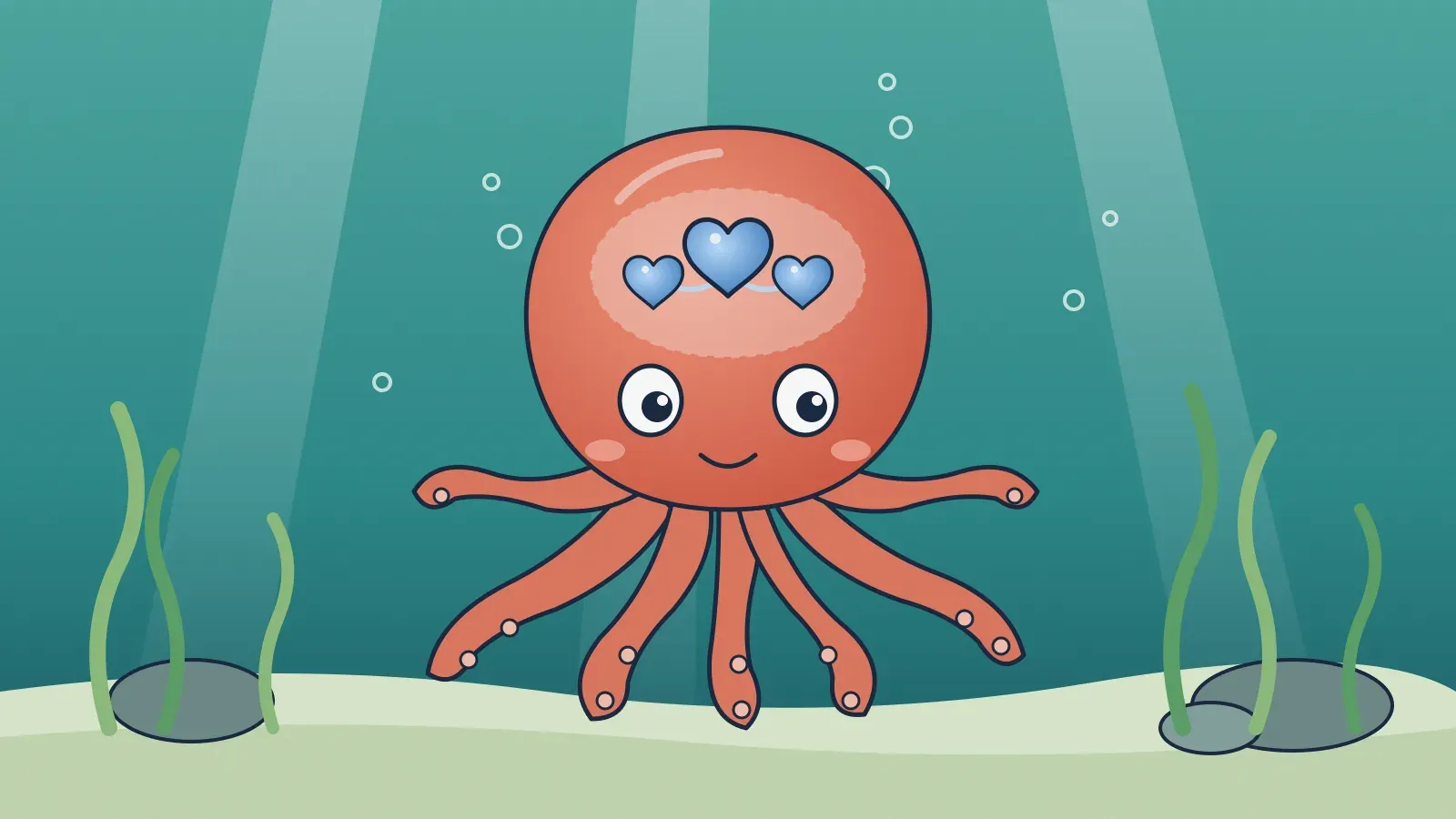
An octopus has three hearts, and none of them is a spare. Two work only for the gills, and the third pushes blood through the rest of the body. On top of that, the blood is blue. The two oddities are connected: both are solutions evolution found for an active, soft-bodied animal that breathes underwater.
What each heart does
Like ours, the octopus circulatory system is closed, but it is laid out differently. There are two branchial hearts, one next to each gill, and one systemic heart in the middle of the body. The branchial hearts receive oxygen-poor blood returning from the body and push it through the gills, where it picks up oxygen. The systemic heart then takes that oxygen-rich blood and sends it to the arms, the brain and the other organs.
| Heart | Number | Job |
|---|---|---|
| Branchial | 2 | Pump oxygen-poor blood through each gill |
| Systemic | 1 | Pump oxygen-rich blood to the rest of the body |
According to biologist Kirt Onthank of Walla Walla University, speaking to Live Science, the systemic heart is the largest and most muscular of the three, while the branchial hearts are small and not especially strong.
Why one heart is not enough
The issue is pressure. As blood squeezes through the tiny vessels of the gills, it loses force. If a single heart had to push it through the gills and then around the whole body, it would reach the tissues at too low a pressure. The octopus solves this by re-pressurizing the blood after it leaves the gills, which is the systemic heart's job. In humans, the left side of the heart plays a similar role: it receives blood from the lungs and pumps it forcefully out to the body.
The heart that stops when the octopus swims
Here is a strange detail: when an octopus swims by jet propulsion, its systemic heart pauses for a few moments. Scientists are not sure exactly why. The most common explanation is that swimming creates high internal pressure and, rather than fight it, the heart simply stops for a moment. A 1962 study also suggested that at rest the systemic heart may stop for long periods while the branchial hearts do most of the work.
Why the blood is blue
Our blood is red because of hemoglobin, an iron-containing protein packed inside red blood cells. Octopuses use a different molecule, hemocyanin, which contains copper instead of iron. Each oxygen-binding site holds a pair of copper atoms. When hemocyanin is loaded with oxygen, the blood is blue; once the oxygen is released, it becomes nearly colorless.
Another key difference: hemocyanin is not kept inside cells. It floats dissolved in the blood fluid (the hemolymph). Octopuses are not alone in this. Hemocyanin is also found in other cephalopods such as squid, in many snails, in crustaceans like shrimp and crabs, in some arachnids and in the horseshoe crab.
An advantage in cold seas
At room temperature, hemocyanin binds oxygen less effectively than hemoglobin. But it performs well in cold, oxygen-poor conditions, which are common in the ocean. A 2015 study in the journal Frontiers in Zoology, led by Michael Oellermann of the Alfred Wegener Institute in Germany, compared the Antarctic octopus Pareledone charcoti with two warmer-water species.
- The Antarctic octopus had at least 40% more hemocyanin in its blood than the other species studied.
- At 10 °C, its hemocyanin released on average 76.7% of the oxygen it carried, compared with 33.0% and 29.8% in the warmer-water species.
- The authors suggest this helps the animal deliver oxygen to its tissues even in sub-zero water.
In short, three hearts and blue blood are not extravagances: together they make up a system that makes up for the pressure lost in the gills and keeps oxygen reaching the body in tough conditions. Next time you see an octopus jet across the water, remember that one of its hearts may be, quite literally, taking a break.