Which country has the most time zones? It's France, not Russia
Counting its overseas territories, France uses 12 different official times, 13 for part of the year. Russia and the United States follow with 11, while vast China keeps a single zone.
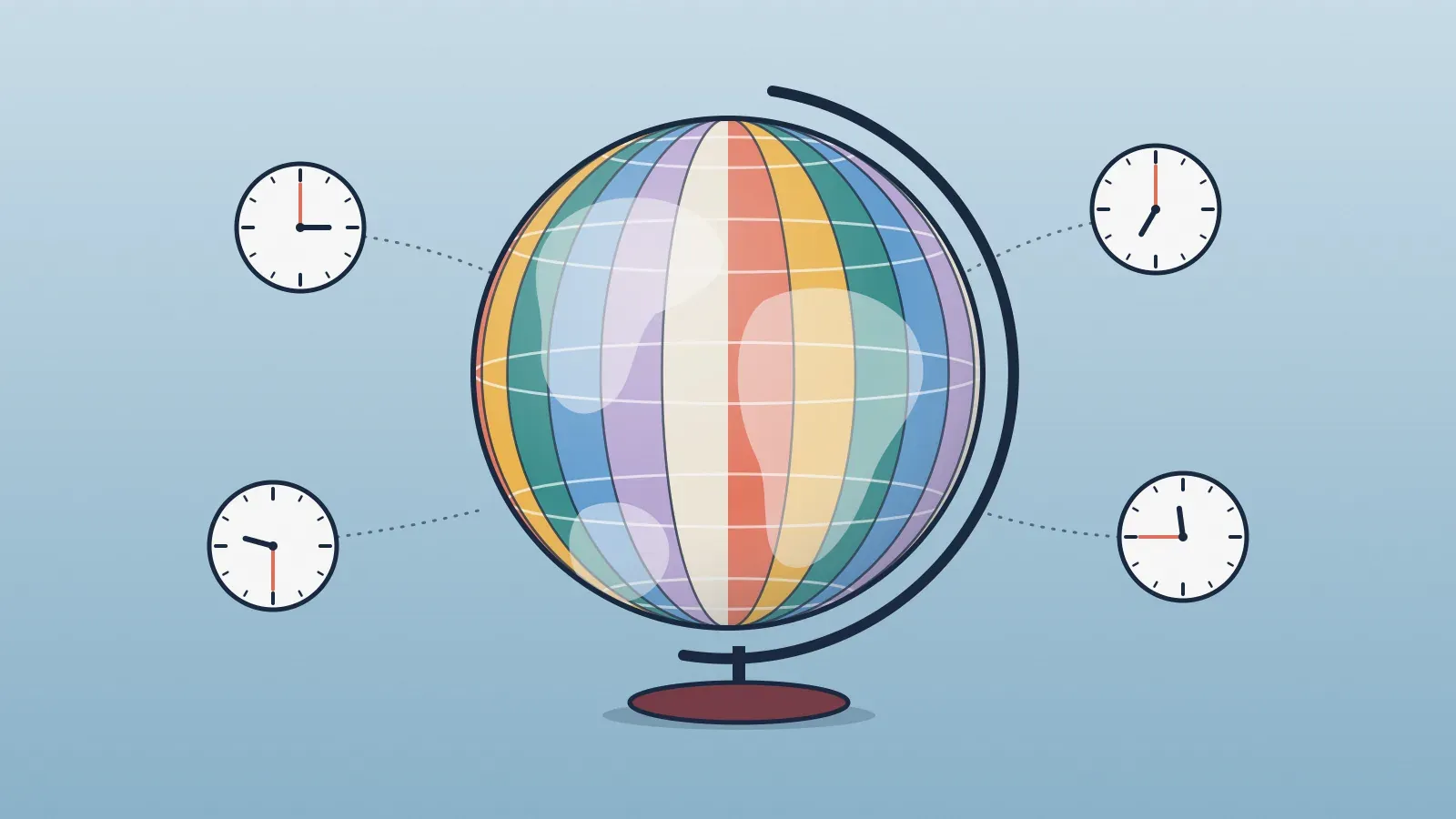
France does. Counting its overseas territories, scattered from the Pacific to the Indian Ocean, the country uses 12 different official times, and 13 when Saint Pierre and Miquelon switches to daylight saving time. Russia and the United States come next, with 11 each. The yardstick is how many legal time zones are in use across a country's territory.
How did France end up with 12 time zones?
Metropolitan France, the part in Europe, runs on a single clock, UTC+1. The other 11 zones come from islands and regions that stayed attached to France after its colonial empire wound down: departments and collectivities in the Caribbean, South America, the Indian Ocean and the Pacific, plus the French Southern and Antarctic Lands. Guinness World Records lists France with 12 time zones, and 13 for part of the year.
| Offset from UTC | Where it applies (examples) |
|---|---|
| −10 | Tahiti, French Polynesia |
| −9:30 | Marquesas Islands |
| −9 | Gambier Islands |
| −8 | A French territory in the eastern Pacific |
| −4 | Guadeloupe, Martinique and Saint Martin, in the Caribbean |
| −3 | French Guiana and Saint Pierre and Miquelon |
| +1 | Metropolitan France |
| +3 | Mayotte |
| +4 | Réunion |
| +5 | French Southern Lands |
| +11 | New Caledonia |
| +12 | Wallis and Futuna |
The 13th appears when Saint Pierre and Miquelon, off the coast of Canada, sets its clocks forward for summer and moves to UTC−2, an offset no other piece of France uses.
How are time zones counted?
In theory, Earth turns 360 degrees in 24 hours, which works out to 15 degrees of longitude per hour: 24 neat slices from pole to pole. In practice, every government sets the official time for its own territory, so legal zone boundaries bend around borders, follow state lines and sometimes use half hours, as in the Marquesas.
That is why rankings count legal zones, not theoretical slices. Each distinct offset from UTC, Coordinated Universal Time, scores one point, half-hour offsets included. Overseas territories count, and daylight saving time is usually left out unless it creates a brand-new offset. The time reference site timeanddate.com also lands on 12 for France, and it includes the strip of Antarctica that France claims. Just as with counting how many countries there are, change the rule and you change the number.
What about Russia and the United States?
Russia has 11 time zones, from UTC+2 in Kaliningrad to UTC+12 in Kamchatka. It is the largest unbroken set in the world: every one of its zones sits on a single landmass stretching from Europe to the Pacific. If the question excluded far-flung territories, Russia would win.
The United States also reaches 11 in timeanddate.com's count, from UTC−12 on Baker Island to UTC+12 on Wake Island, two specks in the Pacific. Under US law, however, there are nine standard time zones, according to the U.S. Naval Observatory:
- Atlantic (UTC−4), used in Puerto Rico and the US Virgin Islands
- Eastern (UTC−5), Central (UTC−6), Mountain (UTC−7) and Pacific (UTC−8)
- Alaska (UTC−9) and Hawaii-Aleutian (UTC−10)
- Samoa (UTC−11), in American Samoa
- Chamorro (UTC+10), in Guam and the Northern Mariana Islands
The gap between 9 and 11 comes from islands with no towns, which are assigned a time but not a zone defined in law. The United Kingdom and Australia come next, with 9 zones each on timeanddate.com's list.
Why does China, so wide, use just one time zone?
China spans more than 60 degrees of longitude, wide enough for five zones, and is almost as broad as the contiguous United States. Before 1949, it used times ranging from UTC+5:30 to UTC+8:30. That year, under Mao Zedong, the government put the whole country on Beijing time, UTC+8, and it has stayed that way. Guinness lists China as the largest country in a single time zone.
The effect is most visible in the far west, thousands of miles from the capital. The official clock reads the same as in Beijing, but the sun rises and sets much later. So in regions such as Xinjiang, an informal local time, closer to the rhythm of the sun, lives alongside the official one.
What time is it across France at noon in Paris?
When it strikes noon in Paris in winter, it is 1 a.m. in Tahiti and 11 p.m. in Wallis and Futuna, both on the same calendar day. That is a 22-hour spread inside one country. Between those two Pacific archipelagos runs the International Date Line, which explains how two island groups in the same ocean can be nearly a full day apart on the clock.
A civil servant calling from New Caledonia to Cayenne, in French Guiana, has to work out a 14-hour difference without ever leaving the country. That sums up the record: less a sign of France's size than a legacy of its history, written into the clocks of islands spread across the three largest oceans.