Why Do Stars Twinkle (and Planets Usually Don't)?
Stars twinkle because turbulent air in the atmosphere bends their light back and forth. Planets, which appear as tiny disks, shine more steadily.
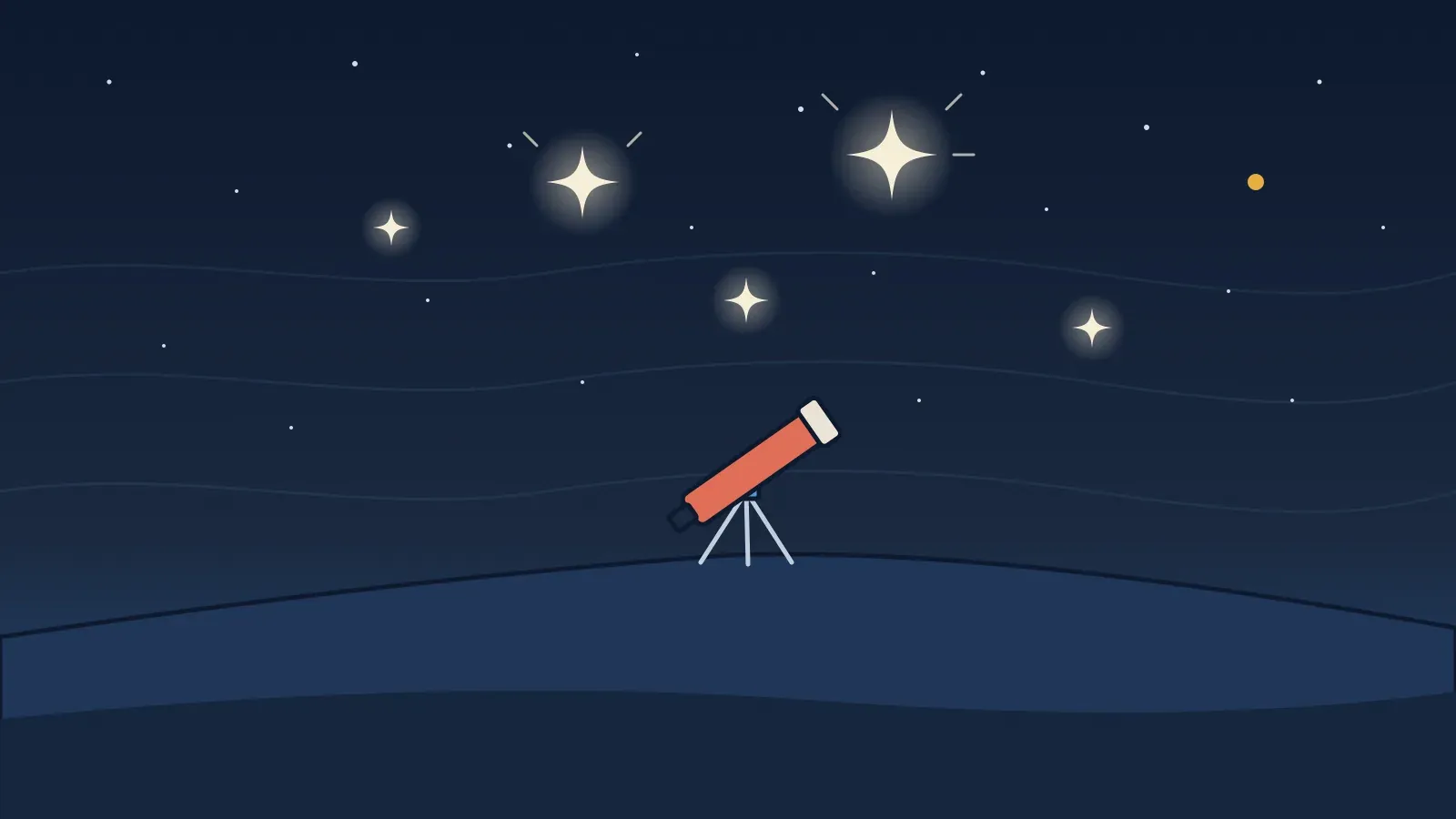
Stars twinkle because their light passes through moving layers of air with different temperatures and densities, which nudge the beam back and forth before it reaches your eyes. The star's actual brightness barely changes; it is the atmosphere that shimmers. Astronomers call this effect scintillation.
What does the atmosphere do to starlight?
Light from a star travels for years through nearly empty space in a straight line. Only at the very end does it enter Earth's atmosphere, and that last stretch is where things get messy. The air is not uniform: there are warmer and cooler pockets, denser and thinner ones, pushed around by the wind. Each time the light passes from one pocket to another, it bends slightly.
That bending is refraction, the same process that splits sunlight into colors inside raindrops to make a rainbow. Because the air pockets keep shifting, the light's path changes from moment to moment. The star's image dances, and sometimes the deflected beam simply misses your pupil for a split second. The light is not lost; it just lands somewhere else. To you, the star seems to flicker off and on.
You can see something similar on a hot day by looking across a stretch of asphalt: distant objects seem to waver. That is air at different temperatures bending light, only on a smaller scale.
Why do stars near the horizon twinkle more?
When you look straight up, light crosses the thinnest possible slice of atmosphere. Near the horizon, it travels through a much longer path of air, with many more pockets along the way. The more air between you and the star, the stronger the twinkling. That is why a bright star that has just risen often flickers far more than one high overhead.
Why don't planets twinkle as much?
It comes down to apparent size. Stars, huge as they are, are so far away that they reach us as single points of light. Planets are much closer and, even though they look like dots to the naked eye, they form tiny disks in the sky. A disk is like many points of light sitting side by side.
Each of those points is also bent by the atmosphere, but not all in the same direction. Light from one edge of the disk shifts one way while light from the other edge shifts the other, and the effects cancel out. On average, the brightness looks steady. The same goes for other objects with a measurable apparent size, such as nebulae: they do not twinkle either. That is why Venus, the planet where a day lasts longer than a year, usually shines so steadily in the evening or morning sky.
There is an exception. A planet sitting low on the horizon, seen through a lot of air, can twinkle too. Still, the rule of thumb is handy for beginners: a bright point high in the sky that does not twinkle has a good chance of being a planet.
Why do some telescopes go to space?
What delights stargazers frustrates astronomers. The same turbulence that makes stars twinkle blurs images taken by telescopes on the ground. The most direct fix is to leave the atmosphere behind. The Hubble Space Telescope, for example, has been in low Earth orbit since 1990, about 300 miles (483 km) up, above that restless air. From there it can also capture some ultraviolet and infrared light that the atmosphere blocks.
How do telescopes on the ground get around twinkling?
Sending telescopes to space is expensive, so astronomers developed a way to correct for turbulence from the ground: adaptive optics. The idea is to measure how the atmosphere is distorting the light and compensate in real time. The basic steps look like this:
- The telescope watches a guide star, real or artificial, near its target.
- A sensor analyzes that star's light about 1,000 times per second to measure the turbulence.
- A deformable mirror changes shape based on those measurements and undoes much of the distortion.
- When no bright star is nearby, a powerful laser excites sodium atoms about 56 miles (90 km) up to create an artificial star.
The European Southern Observatory (ESO) uses this approach on its Very Large Telescope in Chile, and it has made it possible to pick out individual stars at the center of the Milky Way, about 26,000 light-years away. In other words, the flicker that gives a starry night its charm is exactly what astronomers fire lasers into the sky to erase.