How Do Rainbows Form? (And Why the Sun Must Be Behind You)
Rainbows form when sunlight bends, reflects and splits into colors inside raindrops. The bow appears about 42° from the shadow of your head.
A rainbow forms when sunlight enters raindrops, bends, reflects off the back of each drop and comes back out split into colors. Each color leaves at a slightly different angle, close to 42° from the shadow of your head. That is why you only see a rainbow with the sun behind you and rain in front of you.
What happens inside a raindrop?
Sunlight looks white, but it is a blend of every color, each with its own wavelength. It is the same light that, scattered by the air, makes the daytime sky blue. Inside a drop, that blend comes apart in four steps:
- As light passes from air into water, it changes direction. That bending is called refraction.
- Each color bends by a slightly different amount: in water, blue and violet bend more than red. This is dispersion, and it starts pulling the colors apart.
- The light crosses the drop and hits the back wall, where part of it reflects back.
- As it exits the drop, the light refracts again, and the colors spread even further apart.
By the end of the trip, the beam has almost turned around. According to physics teaching material from the University of New South Wales in Australia, blue light is deviated by about 140° and red by about 138°. The difference looks small, but it is enough to paint an arc across the sky.
Why does the 42° angle matter so much?
A drop sends light back at many angles, but not evenly. At one particular angle, lots of rays leave nearly together, and that is where the brightness piles up. For red light, it sits at about 42° from the point in the sky directly opposite the sun, where the shadow of your head would fall. For green it is about 41°, and for violet about 40°.
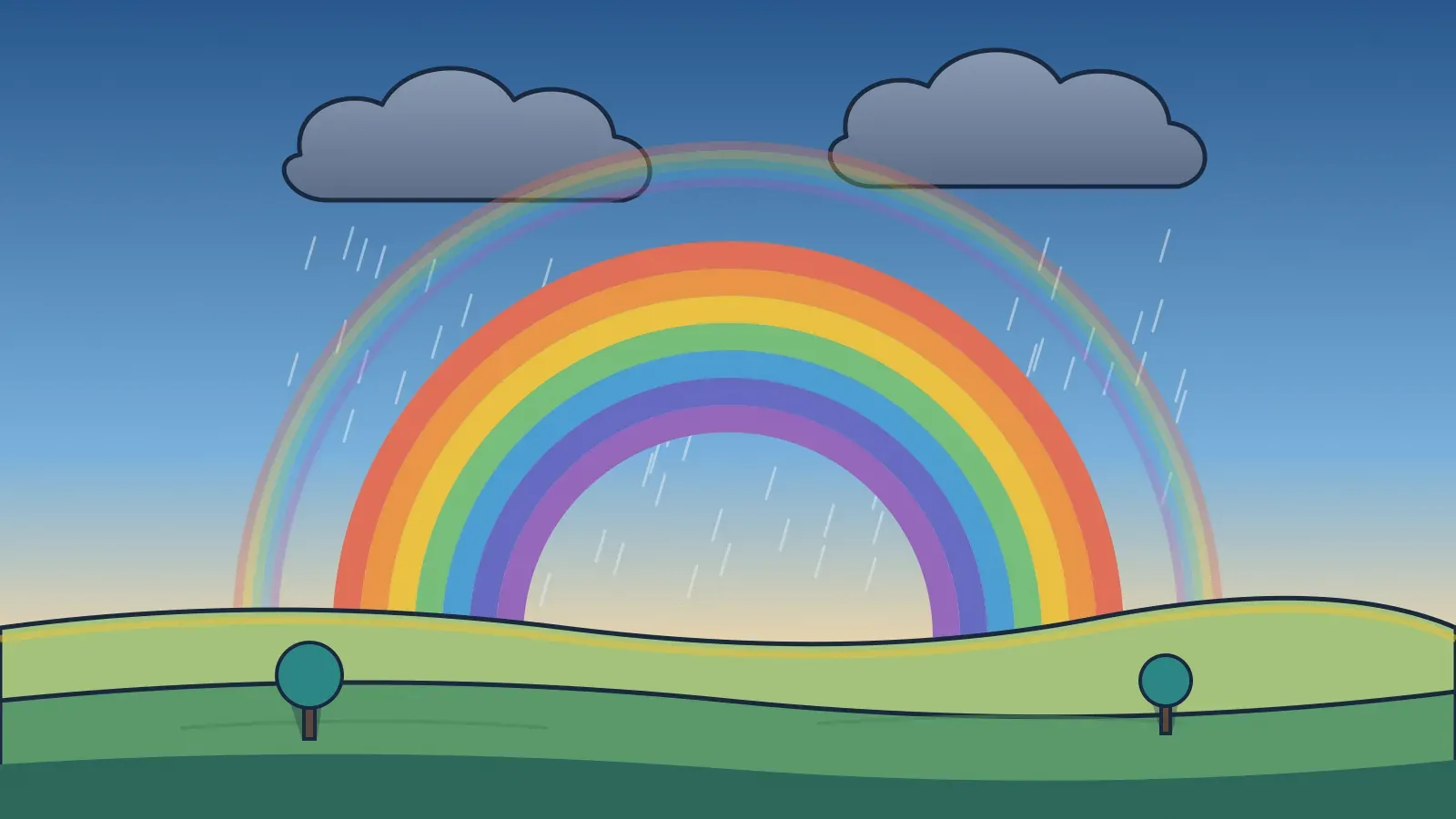
Every drop that sits 42° from that point sends red light to your eyes, and together those drops form a circle. That is why a rainbow is round, with red on the outside and violet on the inside. Usually you see only part of it, because the ground hides the rest of the circle.
This has a curious consequence: each person sees their own rainbow, made by a different set of drops. And its apparent size never changes. A rainbow over the mountains may seem more than half a mile across and one in a lawn sprinkler about three feet, but both span the same angle in your field of view.
Why does the sun have to be behind you?
Because light leaves the drop heading roughly back the way it came, a rainbow always appears on the side of the sky opposite the sun. To see one, you face the rain with the sun at your back. The sun also has to be low: if it is more than 42° above the horizon, the whole arc ends up below the horizon and there is no rainbow to see.
That is why rainbows are most common in the early morning and late afternoon, when a shower passes and the sun comes back out. The lower the sun, the more of the circle you see. At sunset, the arc becomes a half circle whose top stands 42° high. You can try it in the backyard: stand with a low sun behind you, spray a fine mist with a garden hose and look for the colors.
What causes a double rainbow?
Sometimes a second, larger and fainter arc appears outside the first. It comes from light that reflects twice inside the drop before leaving. That extra bounce shifts the exit angle to somewhere between 50° and 53° and flips the order of the colors: in the secondary bow, red is on the inside and blue on the outside. Each extra reflection lets some light escape, so the second bow is dimmer.
Between the two arcs, the sky looks noticeably darker. This strip has a name, Alexander's dark band, and it exists because no drop in that region sends refracted light to you at the angles of either bow. Inside the main arc, by contrast, the sky usually looks brighter.
The same refraction that splits colors inside a drop also works on a much larger scale: in a restless atmosphere, it is what makes stars twinkle at night. And some rainbows are stubborn. The Royal Meteorological Society mentions one recorded in Taiwan in 2017 that stayed visible for about nine hours.