Cleopatra Lived Closer to the Moon Landing Than to the Great Pyramid
Egypt's last queen was born roughly 2,500 years after the Great Pyramid of Giza was finished, yet she died less than 2,000 years before Apollo 11 touched down. Here are the dates and why they reshape our sense of antiquity.
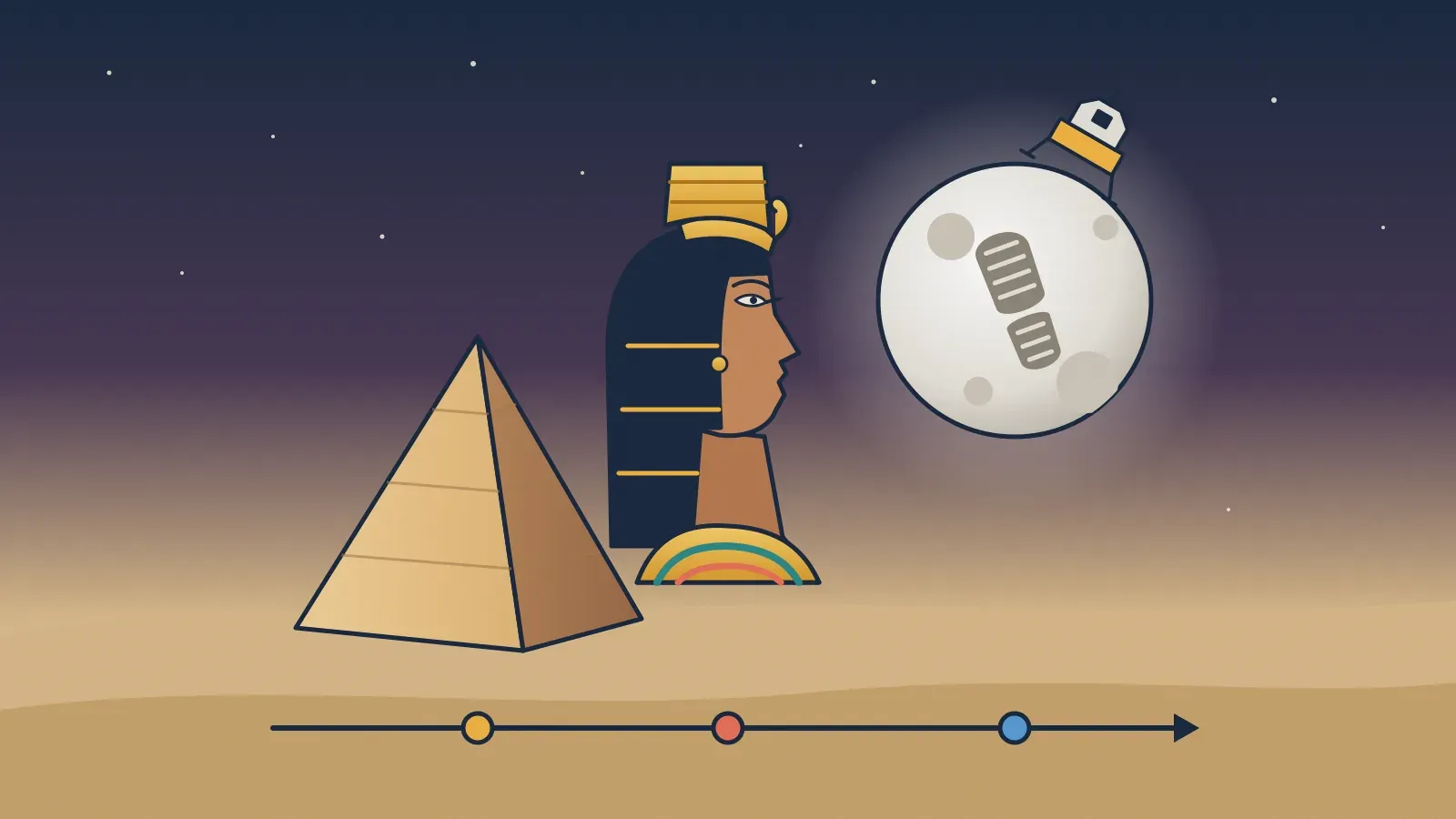
When we picture ancient Egypt, we tend to put Cleopatra and the pyramids in the same scene, as if they belonged to the same era. They did not. When Cleopatra VII died in 30 BC, the Great Pyramid of Giza was already about 2,500 years old. And between the queen's death and Apollo 11 landing on the Moon in 1969, roughly 2,000 years passed. In other words, Cleopatra is closer in time to us than to the builders of the world's most famous pyramid.
When the Great Pyramid was built
The Great Pyramid was raised for the pharaoh Khufu (Cheops in Greek) of the Fourth Dynasty. Egyptologists place Khufu's reign at roughly 2589 to 2566 BC, and the most commonly cited completion date is around 2560 BC. Construction is thought to have taken about 20 years and used more than two million stone blocks.
These dates are approximate. The chronology of Egypt's Old Kingdom is pieced together from king lists, astronomical records and radiocarbon dating, and different scholars arrive at figures that can differ by a few decades. For the comparison in this article, though, that margin makes no difference.
Who Cleopatra was and when she lived
Cleopatra VII was the last ruler of the Ptolemaic dynasty, a Macedonian Greek family that took over Egypt after the death of Alexander the Great. She was born around 70 or 69 BC and died in Alexandria in August 30 BC, after her defeat by Octavian, the future emperor Augustus. The exact day varies by source. With her death, Egypt was annexed by Rome.
To Egyptians in Cleopatra's day, the pyramids of Giza were already ancient monuments tied to kings of a remote past. The queen was further removed from Khufu than we are from her.
The math, side by side
When counting across the turn of the calendar, remember there is no year zero: 1 BC is followed directly by AD 1. With that in mind, the comparison looks like this:
| Milestone | Approximate date | Distance from Cleopatra's death |
|---|---|---|
| Great Pyramid completed | c. 2560 BC | about 2,530 years before |
| Cleopatra VII born | 70 or 69 BC | about 39 years before |
| Cleopatra VII dies | August 30 BC | 0 |
| Apollo 11 lands on the Moon | July 20, 1969 | about 1,998 years after |
The Moon wins by more than 500 years. Even if you use Cleopatra's birth instead of her death, or shift the pyramid's construction a few decades either way, the conclusion holds.
The Moon landing, to complete the picture
Apollo 11's lunar module, Eagle, touched down in the Sea of Tranquility on July 20, 1969. Neil Armstrong took the first step on the surface a few hours later, already July 21 in Universal Time, followed by Buzz Aldrin, while Michael Collins stayed in orbit aboard the command module.
Why this fact surprises us
The effect comes from a common illusion: we compress the distant past into a single block called antiquity. But ancient Egyptian civilization lasted about three thousand years, longer than the span separating us from Cleopatra. A few more points help recalibrate that sense of time:
- The Great Pyramid was the tallest human-made structure for thousands of years; many sources say it was only surpassed by the spire of Lincoln Cathedral in England in the early 14th century.
- Between Khufu and Cleopatra, Egypt went through dozens of dynasties, periods of fragmentation and foreign rule.
- Cleopatra's own dynasty was foreign: the Ptolemies ruled Egypt for about three centuries, long after the age of the pyramids.
In short: the Great Pyramid was finished around 2560 BC, Cleopatra died in 30 BC and humans reached the Moon in 1969. That is about 2,530 years on one side and about 2,000 on the other. Next time someone talks about ancient Egypt as a single moment, remember that it holds layers as far apart as Cleopatra and the Apollo 11 astronauts.