The history of the fork: from scandalous novelty to everyday utensil
The table fork came from Byzantium, was condemned as vanity in medieval Italy and took centuries to spread across Europe. Here is what is fact and what is legend in its story.
Today it seems impossible to set a table without a fork. Yet for much of European history, eating with one was seen as fussy, affected or even a sign of sinful vanity. A knife and fingers did the job. The fork's journey from oddity to essential took nearly a thousand years and runs through Byzantium, Venice, Renaissance Italy and the courts of France and England.
Ancient forks, but not at the table
Fork-shaped objects are very old. In China, bone forks have been found at sites of the Qijia culture, from about 2400 to 1900 BC, and of the Shang dynasty. In ancient Egypt, large forks were used in the kitchen. The Romans had bronze and silver forks. Generally, though, these were tools for cooking, serving or holding meat while it was cut, not utensils for bringing food to the mouth.
Byzantium and the personal fork
The individual table fork probably took hold in the Eastern Roman Empire, the Byzantine Empire, with its capital at Constantinople. Sources disagree on the timing: some speak of common use as early as the 4th century, while others describe the fork as frequent among the wealthy between the 10th and 13th centuries. From the Byzantine world, the custom spread across the Middle East.
The Byzantine princess in Venice
The most famous episode in this story involves Venice, a city with strong ties to Constantinople. In 1004, the Byzantine noblewoman Maria Argyropoulina, sister of the future emperor Romanos III, married Giovanni Orseolo, son of Doge Pietro II Orseolo. Decades later, around 1059, Cardinal Peter Damian wrote about a doge's wife whose food was cut up by her servants; she then lifted it to her mouth with a small golden instrument with two prongs. To him it was an example of excessive luxury, and he presented her early death as divine punishment.
This account should be read with caution. Peter Damian was a moralist using the case as a lesson, not a neutral chronicler. He also does not name the princess. Later Venetian chroniclers attributed the story to another Byzantine, Theodora Doukaina, wife of Doge Domenico Selvo from the 1070s, a version repeated in many books. Modern historians consider it more likely that the text refers to Maria Argyropoulina. So the scene is best treated as a traditional account that captures the culture clash between East and West, not as the exact date the fork reached Europe.
A slow adoption in Europe
In Italy, the fork gradually gained ground from the 11th century, helped by trade with the East and, according to some authors, by the popularity of pasta. It became common around the 14th century and, by 1600, was nearly universal among merchants and wealthy families. In France, tradition says it arrived in 1533 with Catherine de' Medici, who married the future King Henry II, but this attribution is disputed. Either way, the French were also slow to accept it.
England resisted even longer. The traveler Thomas Coryat toured Italy in 1608 and, in his book of 1611, described the Italian custom of eating with a fork. He adopted the habit and was even nicknamed Furcifer, a Latin word that can mean fork-bearer or rascal. For a long time, the English saw the fork as a foreign and unmanly affectation. In the rest of Europe, including Britain, it only became common in the 18th century.
From two tines to four
| Period | Shape | Note |
|---|---|---|
| Antiquity and Middle Ages | Two long, straight tines | Good for spearing, poor for small foods |
| Late 17th century, France | Four slightly curved tines | Less food fell off and the fork worked as a scoop |
| Early 19th century | Four tines | The shape becomes standard in Europe and North America |
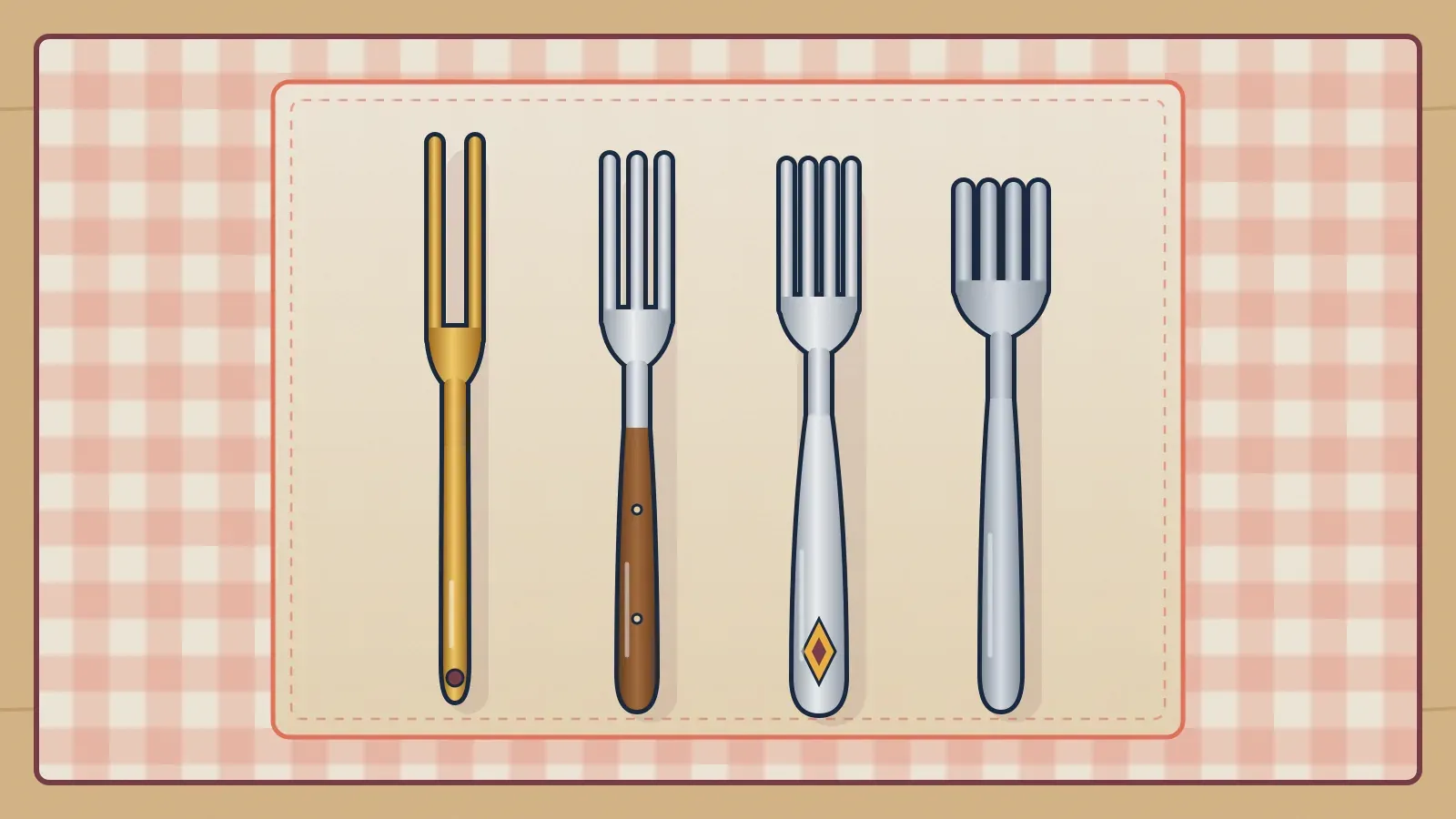
The first table forks copied kitchen forks, with two long, widely spaced tines. They worked for spearing meat, but small morsels slipped between them. More tines, shorter and slightly curved, solved the problem and let the fork scoop food as well. That design, which settled in during the early 19th century, is essentially what we use today.
The history of the fork shows that everyday objects also depend on custom, religion and status. What looks simple today took centuries to stop being a scandal. And it is worth remembering that in much of the world, chopsticks or the hands themselves remain the most traditional way to eat, and the fork is just one possible solution.